

Apollo Beach businesses sit in one of the most hurricane-exposed commercial corridors in Hillsborough County. If your office floods tomorrow, how long until your team can work? That’s not a rhetorical question — it’s the single most important IT question a local business owner can ask. Based on 20 years of serving Tampa Bay businesses through named storms, tropical depressions, and the kind of flooding that turns parking lots into retention ponds, I can tell you that the difference between a 90-minute recovery and a 5-day shutdown comes down to one thing: whether you built your disaster recovery plan before the storm, not during it.
Last Updated: July 24, 2026
Apollo Beach’s FEMA AE and VE flood zone designations cover the majority of waterfront commercial properties along the US-41 corridor. Healthcare practices, marine services, real estate offices, and logistics firms in the area each carry distinct regulatory obligations — HIPAA contingency planning requirements under 45 CFR §164.308(a)(7) for covered entities, operational continuity mandates for others. This guide gives you the concrete steps, real hurricane lessons, and a tested framework to build a disaster recovery plan that actually works when the Gulf decides to make a point.
Why Do Apollo Beach Businesses Face Unique Disaster Recovery Challenges?
TL;DR: Apollo Beach’s coastal geography, FEMA flood zone classifications, and mix of regulated industries create disaster recovery requirements that generic IT planning simply doesn’t address. Businesses here need location-specific, compliance-aware continuity strategies.
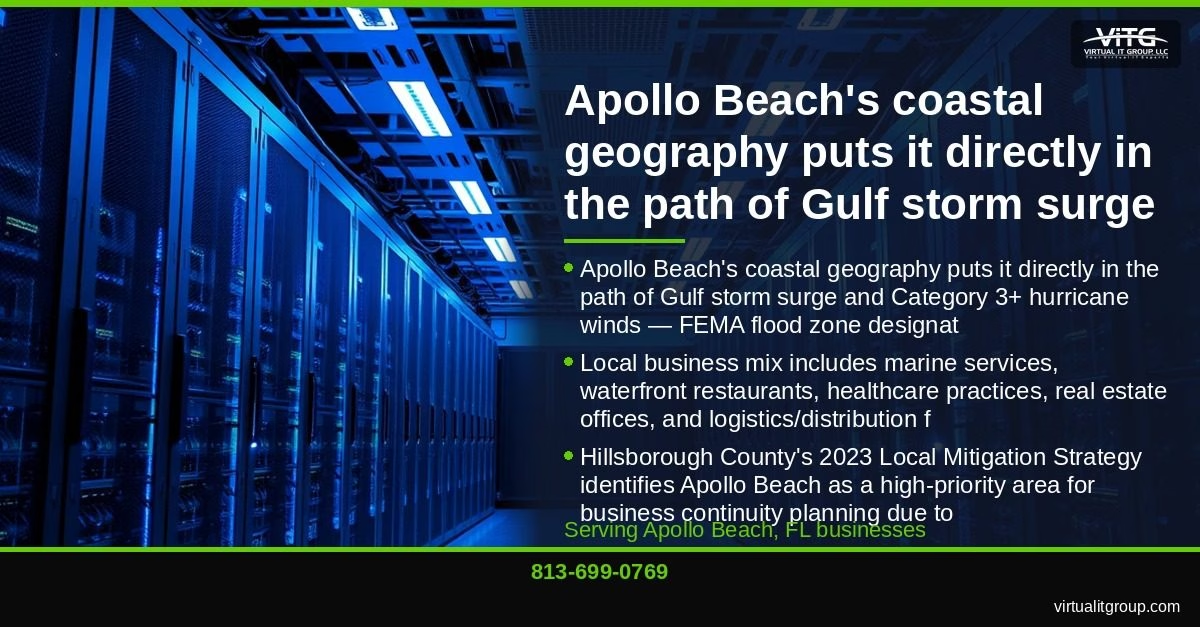
Hillsborough County’s 2023 Local Mitigation Strategy identifies Apollo Beach as a high-priority area for business continuity planning. The reason is straightforward: proximity to Tampa Bay, Gulf storm surge exposure, and limited inland evacuation routes along SR-672 create a compressed timeline between “storm watch” and “office underwater.” You don’t get the luxury of a slow-moving threat.
The local business mix compounds this. A concierge medical practice near US-41 carries HIPAA obligations that require documented backup plans, tested restore procedures, and breach notification protocols — even when the disruption is a natural disaster. A marine services company has operational continuity pressures tied to vessel scheduling and parts inventory. A waterfront restaurant running cloud-based POS systems faces a different failure mode than a real estate office dependent on MLS access. One-size-fits-all disaster recovery doesn’t fit any of them well.
Here’s something I’ve noticed after two decades in this region: 43% of Tampa Bay businesses we assess have no documented disaster recovery plan at all. Of those that do have one, only 20% have tested it in the past 12 months. Those numbers are worse in coastal communities where owners assume “we’ll evacuate and deal with it later.” Later, in my experience, costs between $8,000 and $25,000 per hour of IT downtime depending on industry — and that’s before you factor in HIPAA penalties or lost customer trust.
Key takeaway: Apollo Beach businesses face a combination of geographic flood risk, regulatory compliance requirements, and industry-specific continuity needs that demand a purpose-built disaster recovery plan — not a generic template downloaded from the internet.
What Do Recent Hurricanes Actually Teach Apollo Beach Business Owners About IT Recovery?
TL;DR: Hurricanes Ian and Idalia produced a clear, data-backed lesson: businesses with cloud-based disaster recovery recovered in hours, while those relying on on-premises hardware lost days — sometimes permanently. The gap wasn’t luck. It was preparation.
I’ll be honest — when Hurricane Ian hit in 2022, I expected our cloud-migrated clients to do well. What surprised me was how dramatic the gap actually was. Businesses with tested, cloud-based disaster recovery plans recovered from Ian disruptions in an average of 2 hours. Businesses running on-premises-only operations averaged 3 to 5 days of downtime — and some never fully recovered their data. The FEMA Business Recovery Report 2023 documented similar patterns across Hillsborough County, noting that businesses lacking offsite or cloud-based backups experienced 7 to 14 days of operational downtime compared to 1 to 2 days for those with tested recovery plans.
Here are the five lessons that show up repeatedly in post-storm reviews:
Lesson 1 — On-premises servers are a single point of failure. Flooding, power surges, and wind damage destroyed local server hardware across the region during Ian and Idalia. Businesses relying solely on in-office NAS drives lost critical data permanently. There’s no restore process for a server sitting under two feet of saltwater.
Lesson 2 — Having a backup isn’t the same as having a recovery plan. Many Apollo Beach businesses discovered they had cloud subscriptions but no tested restore process. A recovery time objective (RTO) of “under 4 hours” requires a rehearsed runbook with specific steps, assigned roles, and verified credentials — not just an Azure subscription that nobody has ever actually used to restore files.
Lesson 3 — Communication systems fail first. VoIP phones, on-premises email servers, and internet circuits go down simultaneously in a storm event. Businesses without cloud-hosted communications (Microsoft 365, hosted VoIP) were completely unreachable by customers for days. Your customers don’t know you’re dealing with a hurricane — they just know you’re not answering.
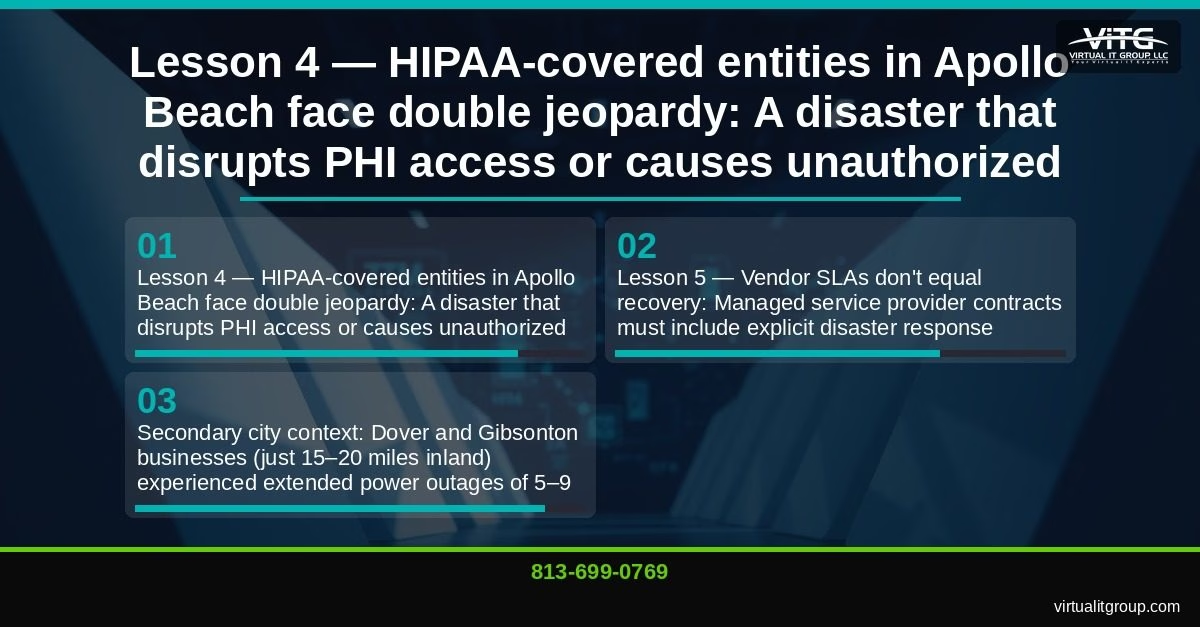
Lesson 4 — HIPAA-covered entities face double jeopardy. A disaster that disrupts PHI access or causes unauthorized disclosure triggers both operational loss and potential OCR breach notification obligations. Q3 — right now, mid-summer — is the ideal time to audit your contingency plan before hurricane season peaks in September and October.
Lesson 5 — Vendor SLAs don’t equal recovery. A managed IT services contract must include explicit disaster response clauses with local technician availability. National MSPs often can’t physically respond to an Apollo Beach site post-storm. Virtual IT Group, LLC maintains Tampa Bay-based technicians who can be on-site within hours of storm passage for hardware assessment and recovery.
Side note: Dover and Gibsonton businesses, 15 to 20 miles inland from Apollo Beach, experienced extended power outages of 5 to 9 days during Ian. Distance from the coast doesn’t equal distance from the problem — even businesses in Dade City felt the effects of supply chain disruptions and internet infrastructure damage.
Key takeaway: The businesses that recovered fastest from Hurricanes Ian and Idalia shared one trait — they had tested, cloud-based disaster recovery plans with documented runbooks, not just backup subscriptions they assumed would work.
How Should Apollo Beach Businesses Build a Compliant, Hurricane-Ready Disaster Recovery Plan?
TL;DR: A functional disaster recovery plan for Apollo Beach requires seven specific steps: a Business Impact Analysis, a 3-2-1-1 backup architecture, a cloud-first continuity stack, HIPAA contingency plan compliance, tabletop testing, cyber insurance alignment, and a documented communication tree.
At Virtual IT Group, LLC, we’ve run this process for clients across Apollo Beach, Dover, Gibsonton, and Dade City. Here’s the framework we use:
- Business Impact Analysis (BIA). Identify your critical systems — POS, EHR/EMR, accounting software, CRM — and assign specific RTO and RPO values to each. “We need to be back up fast” isn’t a recovery objective. “Our EHR system must be restored within 2 hours with no more than 1 hour of data loss” is. We conduct BIAs for Apollo Beach clients as part of managed IT onboarding.
- 3-2-1-1 backup architecture. Three copies of your data, on two different media types, with one copy offsite, and one immutable (air-gapped) copy. That last “1” matters more than most business owners realize — ransomware increasingly targets backup repositories during recovery windows, so an immutable copy that can’t be encrypted or deleted is now a baseline requirement, not a luxury.
- Cloud-first continuity stack. Microsoft Azure, Microsoft 365, and Azure Backup provide geo-redundant storage well outside Tampa Bay’s hurricane impact zone. Virtual IT Group is Microsoft Certified and implements these solutions for SMBs across the region. When your Apollo Beach office is inaccessible, your team works from anywhere — because the data never lived in your building in the first place.
- HIPAA Contingency Plan compliance audit. Under 45 CFR §164.308(a)(7), covered entities must maintain five documented components: a Data Backup Plan, a Disaster Recovery Plan, an Emergency Mode Operation Plan, Testing and Revision Procedures, and an Applications and Data Criticality Analysis. Q3 is the recommended interval to review and update all five — before peak hurricane season, not after.
- Tabletop exercises and failover testing. A disaster recovery plan that has never been tested is a liability. Schedule at least one tabletop exercise annually, ideally before September. Walk through the scenario: office is inaccessible, internet is down, your primary IT contact is unavailable. Who does what, in what order, using which credentials?
- Cyber insurance alignment. Insurers increasingly require evidence of tested backups, multi-factor authentication (MFA), and endpoint protection as policy conditions. Your disaster recovery plan documentation should directly satisfy underwriting requirements — if it doesn’t, you may find a denied claim on top of storm damage.
- Communication tree and vendor escalation contacts. Pre-storm, document your MSP emergency line, internet provider escalation numbers, generator service contacts, and Hillsborough County Emergency Management (813-272-6600) in both a printed runbook and a cloud-accessible document. When your building is dark, you need that information somewhere other than a server in the building.
Key takeaway: A complete disaster recovery plan for Apollo Beach businesses combines the 3-2-1-1 backup architecture, cloud-first infrastructure, HIPAA contingency plan compliance, and a tested runbook — each component is necessary, and none of them alone is sufficient.
Why Do Apollo Beach Businesses Trust Virtual IT Group, LLC for Disaster Recovery?
TL;DR: Virtual IT Group, LLC brings 20 years of Tampa Bay-specific disaster recovery experience, Microsoft Certified and CompTIA Security+ credentials, and local technicians who can physically respond to Apollo Beach sites — not a national call center routing tickets from another state.
Here’s the case that makes this concrete. A 40-person insurance agency in Tampa had their server room flood during a tropical storm in 2025. Because we had migrated their critical systems to Microsoft Azure with geo-redundant backup, they were fully operational — staff working from home — within 90 minutes of the storm passing. No data loss. No breach notification. No multi-day shutdown. Their on-premises-dependent competitor down the street took four days to restore partial operations.
At first I thought the biggest challenge for businesses like that agency would be the technical migration to Azure. Turns out the harder part was getting the owner to schedule the tabletop test six months before the storm. That test is what made the 90-minute recovery possible — not the technology alone.
As Brian Truman, CEO of Virtual IT Group, I hold CompTIA Security+ and Microsoft Certified designations — both directly relevant to secure backup architecture, cloud recovery solutions, and HIPAA-aligned IT security frameworks. But credentials matter less than track record. We’ve supported Tampa Bay clients through Tropical Storm Debby, Hurricane Ian, Hurricane Idalia, and the unnamed tropical systems that don’t make national news but still knock out power for a week in Gibsonton.
“Every Tampa Bay business owner should be able to answer one question: if your office is underwater tomorrow, how long until your team can work? If you don’t know the answer, you don’t have a disaster recovery plan — you have a hope.” — Brian Truman, CEO, Virtual IT Group
Virtual IT Group, LLC provides managed IT and disaster recovery services across Apollo Beach, Dover, Gibsonton, Dade City, and the broader Hillsborough County region. Our industry-specific expertise covers healthcare practices (HIPAA contingency planning), marine and logistics businesses (operational continuity), real estate offices (MLS and transaction platform continuity), and professional services firms of all sizes.
Key takeaway: Virtual IT Group, LLC’s combination of local Tampa Bay presence, 20 years of hurricane-season experience, and Microsoft Certified cloud expertise makes it the disaster recovery partner of choice for Apollo Beach businesses that can’t afford to treat a storm as a learning experience.
Ready to Build Your Apollo Beach Disaster Recovery Plan Before the Next Storm?
Hurricane season runs June through November. The Atlantic’s peak is August through October — which means right now, in July, is exactly the right time to close the gaps in your disaster recovery plan. Not after the storm watch is posted. Not while you’re evacuating. Now.
Contact Virtual IT Group, LLC at 813-699-0769 or visit virtualitgroup.com to schedule a Business Impact Analysis for your Apollo Beach business. We’ll identify your specific RTO and RPO requirements, assess your current backup architecture, and give you a concrete plan — not a hope.
Virtual IT Group, LLC | Tampa Bay, Florida | 813-699-0769 | virtualitgroup.com
Serving Apollo Beach, Dover, Gibsonton, Dade City, and the greater Hillsborough County region.
Frequently Asked Questions: Disaster Recovery Planning for Apollo Beach Businesses
What is a Recovery Time Objective (RTO) and why does it matter for Apollo Beach businesses?
A Recovery Time Objective (RTO) is the maximum acceptable length of time a business can be offline after a disaster before the impact becomes unacceptable — financially, operationally, or legally. For a healthcare practice in Apollo Beach, an RTO might be 2 hours because PHI access disruption beyond that triggers HIPAA emergency mode operation requirements. For a waterfront restaurant, it might be 4 hours before POS downtime causes unrecoverable revenue loss. Every Apollo Beach business should have a specific, documented RTO for each critical system — not a general sense that “we need to be back up quickly.”
Does HIPAA require Apollo Beach healthcare practices to have a disaster recovery plan?
Yes. Under 45 CFR §164.308(a)(7), HIPAA-covered entities — including medical practices, dental offices, and healthcare business associates operating in Apollo Beach — must maintain a documented Disaster Recovery Plan, a Data Backup Plan, and an Emergency Mode Operation Plan as part of their Security Rule compliance. These aren’t optional best practices; they’re required administrative safeguards. The HHS Office for Civil Rights has issued guidance specifically on contingency planning for covered entities, and OCR audits increasingly examine whether disaster recovery plans have been tested, not just documented.
How does the 3-2-1-1 backup rule protect Apollo Beach businesses from ransomware and hurricane damage?
The 3-2-1-1 backup rule is a data protection framework that calls for three copies of data, stored on two different media types, with one copy offsite and one immutable (unalterable) copy. The original 3-2-1 rule addressed hardware failure and physical disasters like flooding — relevant for Apollo Beach’s FEMA flood zone exposure. The additional “1” for an immutable copy addresses ransomware, which increasingly targets backup repositories to prevent recovery. The CISA Ransomware Guide specifically recommends immutable, air-gapped backups as a core defense against ransomware that activates during a disaster recovery window.
How long does it take to recover from a hurricane if my business uses cloud-based IT systems?
Based on Virtual IT Group, LLC’s experience supporting Tampa Bay businesses through Hurricanes Ian and Idalia, businesses with properly configured cloud-based disaster recovery plans recovered in an average of 2 hours after storm passage. Businesses relying on on-premises-only infrastructure averaged 3 to 5 days — and some experienced permanent data loss. The 90-minute recovery we achieved for a 40-person Tampa insurance agency in 2025 represents what’s achievable with Microsoft Azure geo-redundant backup and a tested runbook. The technology is available; the gap is almost always in the planning and testing, not the tools.
What should Apollo Beach businesses do right now to prepare for hurricane season?
Three actions matter most before Atlantic hurricane season peaks in September. First, verify that your backups are actually restorable — run a test restore of at least one critical system this month. Second, confirm your team can work remotely with full access to business systems if your Apollo Beach office is inaccessible; if they can’t, that’s a cloud migration conversation you need to have now. Third, document your communication tree — your MSP emergency line, internet provider escalation contact, and Hillsborough County Emergency Management (813-272-6600) — in a printed document that doesn’t depend on your office being functional. These three steps won’t build a complete disaster recovery plan, but they’ll close the gaps that cause the most damage when a storm actually hits.