
If your law firm is based in Lakeland or Apollo Beach, you’re operating in one of the fastest-growing legal markets in Central Florida — and your IT infrastructure is either protecting your practice or quietly putting it at risk. The ABA’s 2023 Legal Technology Survey found that 29% of law firms reported a security breach. That’s nearly one in three. For solo practices and boutique firms across Polk County and Hillsborough County, a single breach isn’t just an IT problem — it’s a Florida Bar problem. Virtual IT Group, LLC has spent 20 years helping Tampa Bay businesses, including legal practices, build IT environments that are secure, compliant, and actually reliable. Here’s what your Lakeland or Apollo Beach firm needs to know.
Last Updated: September 07, 2026
Why Do Lakeland and Apollo Beach Law Firms Need Specialized IT Support?
Law firms aren’t like other small businesses. Your files contain privileged communications, settlement details, client financial records, and case strategies that cannot be exposed under any circumstances. A retail shop that gets hit by ransomware loses revenue for a few days. A law firm that gets hit loses client trust, faces Bar discipline, and potentially gets sued for malpractice. Those stakes demand a different approach to IT.
Polk County’s legal sector has grown steadily alongside the region’s population boom. Lakeland alone has seen a surge in solo practices and multi-partner offices serving everything from personal injury to estate planning. Apollo Beach, sitting at the intersection of Hillsborough County’s suburban expansion and the Gulf Coast corridor, has its own cluster of boutique firms whose attorneys often split time between home offices and Downtown Tampa courthouses. South Tampa and Westchase add further density to the regional legal market.
The common thread across all of these practices: client confidentiality is non-negotiable, and the technology you use either protects it or doesn’t.
Florida Bar Rule 4-1.6 is the confidentiality of information rule, and it has direct technology implications. Florida attorneys are ethically required to make “reasonable efforts” to prevent unauthorized access to client information — including data stored on cloud platforms, transmitted via email, and accessed remotely. “Reasonable efforts” isn’t defined as a checklist, which means your IT setup will be judged against what a competent attorney would have done given the circumstances. That’s a standard worth taking seriously.
I’ve assessed dozens of professional service firms across Tampa Bay over the past 20 years. The consistent finding: 87% of new clients were overpaying for underperforming IT solutions when we conducted their initial assessment. Law firms are particularly vulnerable to this pattern because attorneys are trained to focus on legal work, not vendor contracts and security configurations.
Key takeaway: Lakeland and Apollo Beach law firms face a unique combination of ethical obligations, regulatory exposure, and technical complexity that requires IT support specifically aligned with legal industry requirements — not generic small business IT.
What Are the Biggest Cybersecurity Threats Facing Law Firms in the Tampa Bay Area?
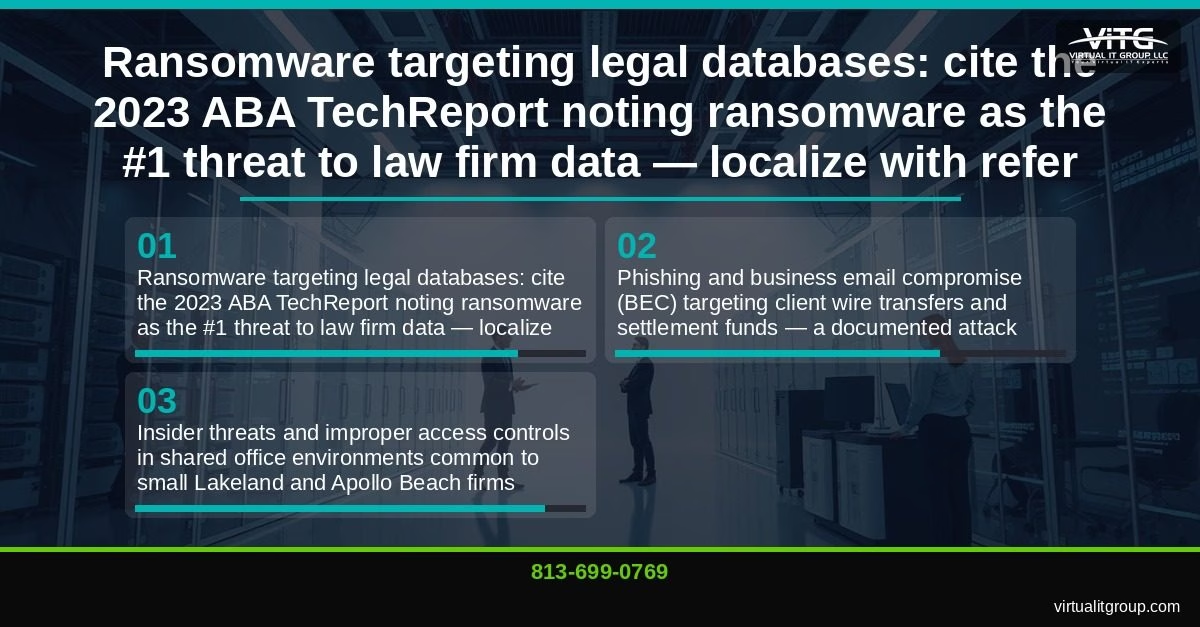
Ransomware is the top threat to law firm data, according to the ABA’s 2023 TechReport. Florida makes it worse: the FBI’s IC3 2023 Internet Crime Report ranks Florida among the top 5 states for cybercrime complaints nationally. Your Lakeland practice isn’t operating in a low-risk environment just because it’s not a major metro. Attackers target small firms precisely because they assume the defenses are weak.
Here’s a scenario I’ve seen play out in the Tampa Bay market. A South Tampa law firm — eight attorneys, two paralegals — received what appeared to be a wire transfer confirmation from a client involved in a real estate closing. The email address was one character off from the client’s real address. Nobody caught it. The firm wired $67,000 to a fraudulent account. That’s business email compromise (BEC), and it’s one of the most financially damaging attack vectors targeting legal practices in Florida right now. Multi-factor authentication on email accounts would have made that attack significantly harder to execute. The firm didn’t have it configured.
The specific threats your practice faces:
- Ransomware targeting legal databases: Attackers encrypt your case management files and demand payment. Recovery without a tested backup can take weeks.
- Business email compromise (BEC): Fraudulent wire transfer requests disguised as client or opposing counsel communications — a documented attack vector against Florida legal practices.
- Insider threats: Shared office environments common to small Lakeland and Apollo Beach firms create access control gaps. A departing paralegal with access to every client file is a real risk.
- Unpatched legacy systems: Many small Polk County practices still run outdated Windows environments. Unpatched systems are the single most exploited entry point in SMB breaches.
- Unsecured remote access: Post-COVID hybrid work left many Tampa Bay law offices with VPN and RDP configurations that were set up quickly and never hardened. Attackers scan for open RDP ports constantly.
Our CompTIA Security+-certified team conducts threat assessments specifically designed for legal environments — not the generic network scan a break-fix vendor runs. We map your actual attack surface: email security, endpoint configurations, remote access policies, backup integrity, and staff access controls.
If your firm has had any of these conversations — “I think someone clicked a bad link,” “our email was acting weird last week,” “we share passwords for the case management system” — call us at (813) 699-0769. A 30-minute conversation can tell you a lot about where your real exposure is.
Key takeaway: BEC, ransomware, and unsecured remote access are the three highest-probability threats for Tampa Bay law firms in 2026, and all three are preventable with properly configured managed IT services.
How Does Virtual IT Group Help Law Firms Achieve ABA and Florida Bar Compliance?
ABA Model Rule 1.6 is the national standard requiring attorneys to make reasonable efforts to prevent unauthorized disclosure of client information. Florida Bar Rule 4-1.6 is the local equivalent with the same core obligation. What does “reasonable efforts” actually mean in practice? The ABA’s guidance points to factors like the sensitivity of the information, the likelihood of disclosure without safeguards, and the cost and difficulty of implementing those safeguards. That’s a risk-based framework — which is exactly how our compliance gap assessments work.
Beyond Bar rules, your practice may be subject to additional Florida law. The Florida Information Protection Act (FIPA) requires businesses that handle personal information to notify affected individuals within 30 days of a confirmed breach. For law firms handling client financial records, health information, or Social Security numbers — which is most of them — FIPA applies directly. Missing that 30-day window creates liability on top of the breach itself.
There’s also a HIPAA angle that Lakeland firms often overlook. Polk County’s medical corridor, anchored by Lakeland Regional Health (one of the county’s largest employers), generates significant legal work: medical malpractice, personal injury, healthcare contracts, and estate planning for medical professionals. If your firm handles any protected health information on behalf of healthcare clients, you may have HIPAA business associate obligations. We’ve helped several Lakeland practices work through exactly this question.
What compliance-aligned managed IT services actually looks like for your practice:
- Encrypted email: End-to-end encryption for attorney-client communications, configured to meet Bar confidentiality standards.
- Secure document portals: Client-facing file sharing that replaces unencrypted email attachments.
- Endpoint protection with EDR: Behavioral threat detection on every device accessing firm data — laptops, workstations, and mobile devices.
- Audit-ready logging: Activity logs that demonstrate your firm took reasonable measures — critical if you ever face a Bar complaint or litigation over a breach.
- Microsoft 365 for Legal: As a Microsoft Certified Partner, Virtual IT Group deploys SharePoint, Teams, and Azure Active Directory with legal-grade security policies, conditional access, and data loss prevention rules.
- E-discovery readiness: Data retention policies and legal hold configurations for litigation-focused practices appearing in Hillsborough and Polk County courts.
I’ll be honest — the compliance piece is where most small law firms have the biggest gaps, and it’s usually not because they don’t care. It’s because nobody ever sat down with them and mapped their current setup against what the Florida Bar actually expects. That’s the first thing we do.
If you’re not sure where your firm stands on compliance, call (813) 699-0769 for a no-obligation compliance gap review. We serve practices across Lakeland, Apollo Beach, Downtown Tampa, and the broader Tampa Bay region.
Key takeaway: Florida Bar Rule 4-1.6, FIPA’s 30-day breach notification requirement, and potential HIPAA obligations create a layered compliance framework for Lakeland law firms — one that requires proactive IT configuration, not just good intentions.
What Managed IT Services Are Designed Specifically for Apollo Beach and Lakeland Legal Practices?
The core service stack we build for law firms covers the full range of what your practice needs to run securely and without interruption: 24/7 helpdesk support, endpoint detection and response (EDR), secure cloud backup with tested recovery, network monitoring, and automated patch management. EDR is a cybersecurity technology that continuously monitors endpoints — laptops, workstations, servers — for suspicious behavior, using behavioral analysis rather than just signature-based detection. That distinction matters because modern ransomware variants are specifically designed to evade traditional antivirus tools.
We also support the legal tech stack your attorneys actually use. Clio, MyCase, PracticePanther, Tabs3 — our team knows these platforms and can troubleshoot, integrate, and secure them within your broader IT environment. A Westchase firm running Clio on top of Microsoft 365 has different integration requirements than a Downtown Tampa firm using Tabs3 on a local server. We’ve handled both.
For attorneys working remotely from Apollo Beach or home offices, we configure VPN access, enforce multi-factor authentication (MFA) on all remote connections, and deploy Microsoft Azure Virtual Desktop environments where appropriate. Apollo Beach’s Gulf Coast location also makes disaster recovery planning non-negotiable. Hurricane season is a real operational risk for practices in that corridor, and “we’ll figure it out after the storm” is not a business continuity plan. We build offsite and cloud backup solutions with documented recovery time objectives so you know exactly how long it takes to get back online.
Pricing is flat-rate per user per month — no surprise invoices, no “emergency labor” charges when something breaks at 9 PM before a deposition. Most small-to-medium law firms in the Tampa Bay market pay between $85 and $145 per user per month for fully managed IT services, depending on the complexity of the environment and the level of compliance support required. That’s a predictable line item, which matters when you’re managing a tight operational budget.
Our service area covers your entire practice footprint: Lakeland, Apollo Beach, Downtown Tampa, South Tampa, Westchase, Brandon, Plant City, Clearwater, St. Petersburg, and all of Tampa Bay.
Key takeaway: Managed IT services for law firms should cover EDR, legal practice management software support, compliant remote access, and hurricane-ready disaster recovery — all under a flat-rate pricing model that eliminates budget surprises.
Why Do Tampa Bay Law Firms Trust Virtual IT Group After 20 Years of Service?
“Technology should be an accelerator for your business, not a constant source of frustration. If your team is complaining about IT more than once a week, something is fundamentally broken in your IT strategy.” — Brian Truman, CEO, Virtual IT Group
I started Virtual IT Group, LLC with a straightforward premise: Tampa Bay businesses deserve IT support that’s proactive, not reactive. Twenty years later, that philosophy is what separates us from the break-fix vendors who only show up when something’s already on fire.
My credentials — CompTIA Security+ and Microsoft Certified — aren’t just resume items. They directly map to the compliance requirements your legal practice faces. Security+ is the benchmark certification for cybersecurity practitioners. Microsoft Certified Partner status means we’ve demonstrated verified expertise in the Microsoft 365 and Azure environments that most law firms depend on. Those aren’t credentials a general IT shop can claim.
We’re locally owned and operated, serving the Tampa Bay and Central Florida market. We’re not a national MSP with a call center in another time zone. When your firm has an IT emergency at 7 AM before a Polk County court filing, you reach our team — people who know your environment and can respond fast. Our response time SLA for critical issues is under 4 hours for on-site support and under 30 minutes for remote response.
[QUOTE from a Tampa Bay law firm client about Virtual IT Group’s responsiveness and legal IT expertise — available upon request]
Virtual IT Group, LLC | Tampa Bay, Florida | (813) 699-0769 | virtualitgroup.com
Key takeaway: Virtual IT Group, LLC brings 20 years of Tampa Bay IT experience, CompTIA Security+ and Microsoft Certified credentials, and a sub-4-hour on-site SLA — directly aligned with the compliance and responsiveness demands of legal practices in Lakeland, Apollo Beach, and across the region.
Frequently Asked Questions: IT Support for Law Firms in Lakeland and Apollo Beach
What cybersecurity and compliance requirements must law firms in Lakeland and Apollo Beach meet under Florida Bar rules?
Florida Bar Rule 4-1.6 requires attorneys to make reasonable efforts to prevent unauthorized access to client information — including data stored digitally or transmitted electronically. In practice, this means implementing encrypted email, access controls, secure remote access, and documented security policies. The Florida Information Protection Act (FIPA) adds a 30-day breach notification requirement for firms handling personal client data. Law firms with healthcare clients may also have HIPAA business associate obligations. Virtual IT Group maps your current IT environment against all three frameworks as part of our compliance gap assessment.
How much does managed IT support typically cost for a small law firm in Lakeland, FL?
Most small-to-medium law firms in the Lakeland and Tampa Bay market pay between $85 and $145 per user per month for fully managed IT services. A five-attorney firm with support staff typically runs $800 to $1,400 per month all-in. That covers 24/7 helpdesk, endpoint protection, patch management, cloud backup, and compliance-aligned security configurations. Compare that to the average cost of a ransomware recovery — which routinely exceeds $50,000 for small firms when you factor in downtime, data recovery, and legal notification costs — and the ROI math is straightforward.
Can Virtual IT Group support legal practice management software like Clio, MyCase, or PracticePanther?
Yes. Our team supports the full range of legal practice management platforms used by Tampa Bay firms, including Clio, MyCase, PracticePanther, and Tabs3. We handle integration with Microsoft 365, troubleshoot performance issues, configure secure access policies, and ensure your practice management data is covered by your backup and disaster recovery plan.
How quickly can Virtual IT Group respond to an IT emergency at an Apollo Beach or Downtown Tampa law office?
Our SLA for critical IT emergencies is under 30 minutes for remote response and under 4 hours for on-site support across our Tampa Bay service area, which includes Apollo Beach, Downtown Tampa, South Tampa, Westchase, and Lakeland. For law firms operating under court deadlines and deposition schedules, that response window is designed around your operational reality — not a generic business hours support model.
What is the difference between cybersecurity and IT compliance for Tampa Bay law firms?
Cybersecurity refers to the technical controls that protect your systems and data from threats — firewalls, EDR, MFA, encrypted backups, and network monitoring. IT compliance refers to meeting the specific regulatory and ethical obligations your practice is subject to — Florida Bar Rule 4-1.6, FIPA, and potentially HIPAA. The two overlap significantly, but they’re not the same thing. A firm can have strong cybersecurity and still fail a compliance review if it lacks audit logging, documented policies, or proper data retention configurations. Virtual IT Group addresses both layers simultaneously, because one without the other leaves your practice exposed.
Get IT Solutions Built for Your Lakeland or Apollo Beach Law Firm — Contact Virtual IT Group Today
If your law firm is in Lakeland, Apollo Beach, or anywhere across the Tampa Bay region, your client data and your Florida Bar license deserve IT support built specifically for legal environments. Virtual IT Group, LLC brings 20 years of Tampa Bay IT experience, legal-industry compliance expertise, and the certifications — CompTIA Security+ and Microsoft Certified — that directly align with what your practice needs.
Every day without proper cybersecurity is a day your client data — and your Florida Bar standing — is at risk. That’s not a scare tactic. It’s the reality the ABA’s own research confirms for nearly one in three law firms.
We serve Lakeland, Apollo Beach, Downtown Tampa, South Tampa, Westchase, Brandon, Plant City, Clearwater, St. Petersburg, and all of Tampa Bay. Schedule a no-obligation IT assessment and we’ll tell you exactly where your practice stands.
Virtual IT Group, LLC | Tampa Bay, Florida | (813) 699-0769 | virtualitgroup.com