
If your business operates along Florida Avenue, North Nebraska Avenue, or anywhere in the Seminole Heights corridor, there’s a question worth asking yourself right now: if someone stole your Microsoft 365 password tonight, what would stop them from logging in? For most small businesses in this neighborhood, the honest answer is nothing. That’s the core problem multi-factor authentication (MFA) solves, and it’s why I’m writing this directly to you.
Last Updated: November 18, 2026
Multi-factor authentication (MFA) is a security control that requires users to verify their identity through two or more independent factors before gaining access to an account or system. It is the single most effective technical control for preventing unauthorized account access — and it blocks over 99% of automated credential-based attacks, according to Microsoft’s own security research.
Seminole Heights has become one of Tampa’s most economically active neighborhoods. The independent restaurant scene, creative agencies, craft breweries, and boutique retailers that define this community are exactly the kind of businesses that cybercriminals now specifically target — not because they’re high-profile, but because they’re often under-protected. At Virtual IT Group, LLC, we’ve spent 20 years watching this threat evolve across Tampa Bay, and the pace has accelerated sharply.
Why Are Seminole Heights Businesses Being Targeted by Credential-Based Cyberattacks?
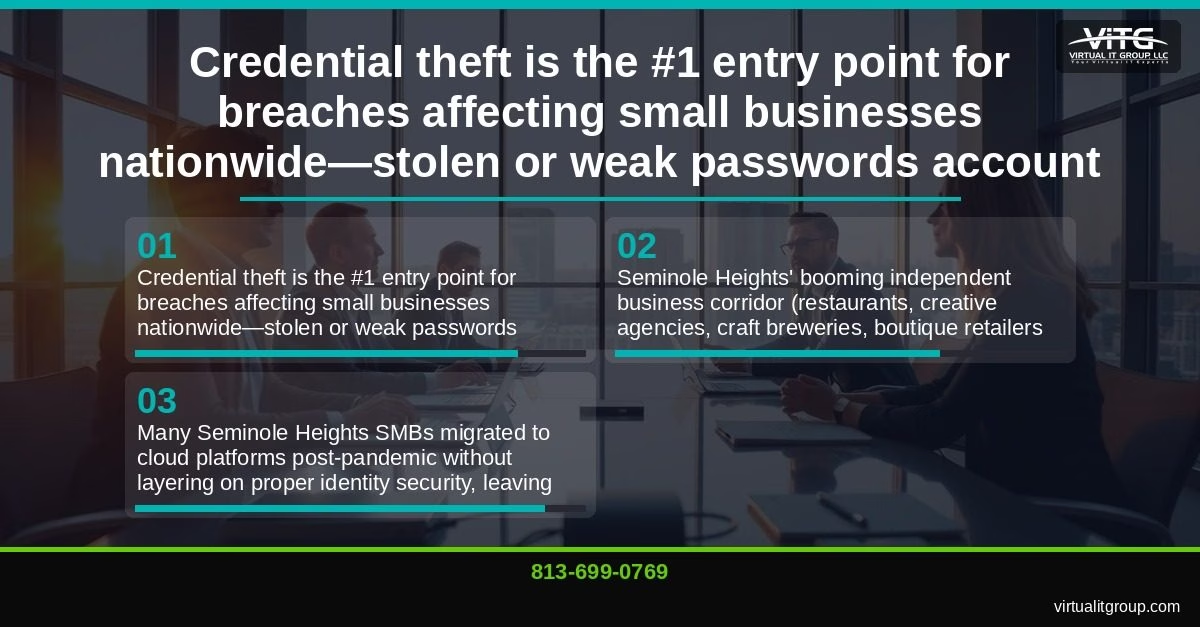
Credential theft is the number one entry point for breaches affecting small businesses. It’s not a new problem, but the scale has changed. Stolen or weak passwords now account for the majority of unauthorized access incidents reported to the FBI’s Internet Crime Complaint Center (IC3), with business email compromise (BEC) losses to small businesses running into the billions annually.
Here’s what makes Seminole Heights specifically interesting to threat actors: the neighborhood’s booming independent business corridor creates a dense cluster of small businesses sharing common cloud tools. QuickBooks Online, Microsoft 365, Square, Toast POS — these platforms are everywhere along Florida Ave and N. Nebraska Ave. When dozens of businesses in close proximity use the same cloud services without consistent identity security, attackers can run automated credential-stuffing campaigns against all of them simultaneously.
The broader Tampa Bay context matters too. The region’s proximity to MacDill Air Force Base, Port Tampa Bay, and major healthcare networks makes it a higher-value target for threat actors seeking supply-chain entry points through smaller vendors. A Seminole Heights marketing agency that does contract work for a defense-adjacent firm becomes an indirect attack surface. A Gibsonton logistics company that subcontracts for Port Tampa Bay shippers carries real risk for its larger partners.
Many Seminole Heights businesses migrated to cloud platforms during and after the pandemic — a smart operational move — without layering on proper identity security. That migration created a window of exposure that hasn’t fully closed. In my 20 years serving Tampa Bay businesses, I’ve seen a measurable uptick in BEC attempts targeting local service businesses specifically because of this gap.
Key takeaway: Credential-based attacks are the dominant threat vector for small businesses, and Seminole Heights’ dense concentration of cloud-dependent SMBs sharing common platforms makes the neighborhood a concentrated target for automated credential attacks.
What Is Multi-Factor Authentication and How Does It Protect Tampa Bay Small Businesses?
Multi-factor authentication (MFA) is a login security method that requires a user to provide two or more verification factors from different categories: something you know (a password or PIN), something you have (a smartphone app, hardware token, or security key), or something you are (a fingerprint or face scan). Requiring at least two of these factors means a stolen password alone cannot grant access.
For a Seminole Heights marketing agency with a team accessing Microsoft 365 remotely, MFA typically looks like this: an employee enters their password, then receives a push notification to an authenticator app on their phone. They tap “Approve” and they’re in. Takes about five seconds. For a higher-risk environment — a law firm or dental practice handling sensitive records — a physical FIDO2 hardware security key provides stronger protection than a phone-based push, because it can’t be intercepted by a SIM-swap attack or a sophisticated phishing page.
The contrast with password-only security is stark. A 16-character password that took months to crack ten years ago can now appear in a dark-web credential-stuffing list within hours of a breach at any one of the dozens of services where your employees reuse it. Once it’s on that list, automated bots will try it against every major cloud platform within minutes. MFA breaks that entire attack chain.
It’s worth being precise about MFA types, because not all MFA is equal:
- SMS-based MFA: A one-time code sent via text message. Better than nothing, but vulnerable to SIM-swapping and real-time phishing attacks. Acceptable for lower-risk applications.
- Authenticator app (TOTP/push): Apps like Microsoft Authenticator or Google Authenticator generate time-based codes or push notifications. Significantly stronger than SMS and practical for most SMB teams.
- FIDO2/Passkeys and hardware security keys: Phishing-resistant by design. The key cryptographically verifies the legitimate site before responding. Recommended for admin accounts, financial access, and industries like legal, dental, and financial services common throughout Tampa Bay.
I’ll be honest — I used to think SMS-based MFA was “good enough” for most clients. After investigating several BEC incidents where attackers bypassed SMS codes through real-time phishing proxies, I changed that position. The authenticator app is now our baseline recommendation for every account, with hardware keys for anything privileged.
If your team is on Microsoft 365 and you haven’t enabled MFA yet, call us at (813) 699-0769 — we can walk through what enabling it looks like for your specific setup in under 30 minutes.
Key takeaway: MFA blocks over 99% of automated account-takeover attempts by making a stolen password alone insufficient for access; authenticator-app-based MFA is the practical baseline for Tampa Bay SMBs, with phishing-resistant FIDO2 keys recommended for privileged and high-risk accounts.
Florida Compliance and Cyber Insurance Pressures Driving MFA Adoption in Hillsborough County
Regulatory pressure on Florida businesses to implement MFA has never been higher. Several overlapping frameworks now either require or strongly incentivize it, and if your business operates in Hillsborough County, at least one of these almost certainly applies to you.
Florida HB 473 (Florida Digital Bill of Rights) establishes accountability for businesses that collect consumer personal data. MFA is a foundational technical safeguard under any reasonable interpretation of “reasonable security measures” — and Florida’s enforcement trend is toward specificity, not vagueness.
The FTC Safeguards Rule (updated requirements now in full effect) mandates MFA for financial institutions and auto dealerships — several of which operate throughout the Tampa and Hillsborough County corridor. If your business touches consumer financial data, this rule likely applies to you directly.
PCI DSS v4.0, fully enforced as of 2025, requires MFA for all access to cardholder data environments. For Seminole Heights restaurants and retailers processing card payments — which is essentially every business on that corridor — this is a compliance requirement, not a recommendation. The PCI Security Standards Council documentation is explicit on this point.
The HIPAA Security Rule technical safeguard requirements affect the medical and dental practices operating in and around the Seminole Heights and broader Tampa area. While HIPAA doesn’t name MFA by brand, the access control and audit control requirements effectively require it for any practice that takes its compliance obligations seriously.
The cyber insurance angle is the one I see catching businesses off guard most often. Underwriters are now requiring documented MFA policies as a condition of coverage — or they’re excluding credential-based breach claims for businesses without it. A Dover-based HVAC company we spoke with recently discovered their policy contained a clause that would have voided their ransomware coverage if MFA wasn’t enabled on remote access. They had no idea. Virtual IT Group, LLC helps clients build audit-ready MFA configurations and policy documentation across all of these frameworks.
If you’re unsure whether your current coverage requires MFA, that’s a conversation worth having before a breach — not after. Call (813) 699-0769 to schedule a compliance review.
Key takeaway: Florida businesses face MFA requirements from multiple overlapping frameworks — PCI DSS v4.0, FTC Safeguards Rule, HIPAA, and Florida HB 473 — and cyber insurance policies increasingly exclude breach claims for businesses that haven’t implemented MFA.
How Does Virtual IT Group Deploy MFA for Businesses Across Seminole Heights, Dover, Gibsonton, and Dade City?
Deploying MFA isn’t just flipping a switch in your Microsoft 365 admin panel — though that’s part of it. The businesses that run into trouble are the ones that enable MFA without a plan and then spend the next two weeks fielding panicked calls from employees who can’t log in. Here’s how our team handles it.
Step 1: Discovery and risk assessment. We audit every existing account, cloud service, VPN access point, and remote desktop environment. You’d be surprised how many businesses have forgotten cloud accounts — old HR platforms, legacy accounting tools, a vendor portal from three years ago — that still have active credentials. We map all of it before recommending anything.
Step 2: Solution selection. For Microsoft 365 environments, we deploy Microsoft Entra ID (formerly Azure AD) MFA with Conditional Access policies. For mixed-platform or legacy-application environments, Duo Security provides broader compatibility. For high-privilege admin accounts — the accounts that, if compromised, would give an attacker full control of your environment — we configure hardware FIDO2 security keys. The NIST SP 800-63B digital identity guidelines provide the framework we use to match authentication assurance levels to account risk.
Step 3: Phased rollout. We start with privileged accounts and email — the highest-risk access points — then expand to all staff over a planned window. For a 15-person Seminole Heights creative agency, this typically takes one to two weeks. For a Dade City business with remote workers across multiple sites, we build in additional testing time and remote support coverage.
Step 4: Staff training and helpdesk support. User friction is the silent killer of MFA deployments. If employees find the new login process confusing or annoying, they’ll find workarounds — shared accounts, disabled MFA prompts, whatever it takes. Our team provides onboarding documentation and live training sessions tailored to your staff’s technical comfort level.
Step 5: Ongoing monitoring. MFA logs feed into our SIEM and SOC monitoring to detect anomalous login patterns. An “impossible travel” alert — where the same account appears to log in from Tampa and Eastern Europe within 20 minutes — is an immediate red flag. For a Gibsonton logistics firm with remote workers, this kind of monitoring is what distinguishes a legitimate remote login from a compromised one.
We provide on-site visits across Tampa Bay including Seminole Heights, Dover, Gibsonton, and Dade City, with same-business-day remote support available for urgent issues.
Key takeaway: A successful MFA deployment requires discovery, solution matching, phased rollout, staff training, and ongoing log monitoring — skipping any step increases the risk of gaps that attackers can exploit or user friction that causes employees to bypass controls.
Real-World Scenarios: What Happens to Tampa Bay Businesses Without MFA?
These scenarios reflect the types of incidents our security team has investigated and remediated across the Tampa Bay region over 20 years. Names and details are generalized to protect client confidentiality.
Scenario 1 — Business Email Compromise, Seminole Heights: A boutique marketing agency has an employee’s Microsoft 365 credentials phished via a convincing fake DocuSign email. Without MFA, the attacker logs in within minutes, sets up silent inbox forwarding rules, and monitors email for weeks. When a client wire transfer is being coordinated, the attacker intercepts the thread and substitutes their own bank account details. With MFA enabled, the stolen password is worthless — the attacker can’t get past the second factor.
Scenario 2 — Ransomware via Remote Desktop Protocol, Dover: A facilities and HVAC company uses Remote Desktop Protocol (RDP) so technicians can access job management software from the field. Over a weekend, an attacker runs an automated brute-force attack against the exposed RDP port. By Monday morning, ransomware has encrypted the job management database, scheduling system, and three years of client records. With MFA on the RDP gateway, the brute-forced password alone can’t open a session.
Scenario 3 — Vendor Supply Chain, Gibsonton: A logistics company subcontracting for a Port Tampa Bay shipper has its business email compromised. The attacker impersonates the logistics company in email correspondence with the shipper’s accounts payable team, redirecting a payment. MFA on the logistics company’s email would have prevented the initial compromise entirely — the attacker never gets into the inbox.
As I tell clients directly: “In nearly every breach investigation we’ve conducted for Tampa Bay SMBs, the attack vector was a valid credential with no second factor. MFA is not optional anymore — it is the baseline.” — Brian Truman, CompTIA Security+, Microsoft Certified, CEO, Virtual IT Group
Key takeaway: Business email compromise, ransomware via RDP, and vendor supply-chain attacks all share a common root cause — valid credentials with no second factor — and MFA directly blocks the initial access step in each scenario.
Frequently Asked Questions About MFA for Seminole Heights and Tampa Bay Businesses
Does my small business in Seminole Heights actually need multi-factor authentication, or is it just for large companies?
Your Seminole Heights business absolutely needs MFA — and the “it’s only for big companies” assumption is one of the most dangerous misconceptions I encounter. Attackers don’t manually select targets based on company size. Automated credential-stuffing tools run against millions of accounts simultaneously, and small businesses are disproportionately targeted because they’re statistically less likely to have MFA enabled. The FBI IC3 reports that small businesses are among the most frequent BEC victims precisely because of this gap. If your business uses any cloud platform — Microsoft 365, QuickBooks Online, a POS system — MFA is the baseline protection those accounts require.
How much does it cost to set up MFA for a small business in the Tampa Bay area?
The cost depends on several factors: how many users you have, which platforms need protection, whether you’re already licensed for a tool like Microsoft Entra ID (which is included in many Microsoft 365 business plans), and whether you need hardware security keys for privileged accounts. Many Tampa Bay businesses find that MFA is already included in software they’re paying for but haven’t activated. For businesses that need a third-party solution like Duo Security, pricing scales with user count and feature tier. The most accurate way to understand your specific cost is to call (813) 699-0769 — we’ll assess your environment and give you a clear picture with no obligation.
Will MFA slow down my employees or disrupt daily operations at my Tampa Bay business?
A well-configured MFA deployment adds roughly three to five seconds to each login. That’s the honest answer. The disruption risk comes from a poorly planned rollout — enabling MFA without training, without testing, or without a helpdesk support plan. Our phased deployment approach specifically addresses this: we start with a small group, work out any friction points, then expand. Most teams adapt within two to three days. The temporary adjustment period is a small price compared to the weeks of recovery work that follows a breach.
What happens to my cyber insurance policy if I don’t have MFA enabled in Florida?
This is a question more Florida business owners should be asking before they file a claim, not after. Cyber insurance underwriters now routinely include MFA requirements in policy language. If you experience a credential-based breach — which covers the majority of ransomware and BEC incidents — and your insurer determines MFA was not enabled on the compromised accounts, your claim may be denied or significantly reduced. Several of our clients in the Tampa Bay area have had coverage gaps identified during their annual policy reviews. Virtual IT Group, LLC can help you document your MFA configuration in a format that satisfies underwriter requirements. Call (813) 699-0769 to discuss your current policy situation.
Can Virtual IT Group set up MFA for businesses in Dover, Gibsonton, and Dade City, not just Tampa proper?
Yes. Our service area covers all of Hillsborough, Pasco, and Pinellas counties, including Seminole Heights, Dover, Gibsonton, Dade City, Brandon, Riverview, Apollo Beach, Plant City, Clearwater, and St. Petersburg. We provide on-site visits throughout this area and same-business-day remote support for urgent issues. The operational context differs between an urban Seminole Heights agency and a Gibsonton logistics operation — we account for those differences in how we design and deploy MFA solutions.
Get MFA Deployed for Your Seminole Heights Business — Contact Virtual IT Group Today
If you’ve read this far, you already know the risk is real. The question is whether you address it before an incident or after one. In my experience, the businesses that act proactively spend a fraction of what reactive recovery costs — in time, money, and client trust.
Virtual IT Group, LLC has served Tampa Bay businesses for 20 years. I hold CompTIA Security+ and Microsoft certifications and lead our cybersecurity practice personally. When you call us, you’re talking to people who know the Seminole Heights business community, who understand the compliance landscape for Florida businesses, and who have investigated the kinds of breaches described in this article firsthand.
Schedule a free MFA readiness assessment for your Seminole Heights business — no obligation, results delivered within 48 hours.
We serve businesses across:
- Seminole Heights and Tampa
- Dover, Gibsonton, and Dade City
- Apollo Beach, Brandon, and Riverview
- Plant City, Clearwater, and St. Petersburg
- All of Hillsborough, Pasco, and Pinellas counties
Virtual IT Group, LLC
Serving Seminole Heights, Tampa, and the greater Tampa Bay area
Phone: (813) 699-0769
Website: virtualitgroup.com
Call (813) 699-0769 today or visit virtualitgroup.com to schedule your assessment. MFA deployment for most small businesses takes less than two weeks. The next credential-stuffing campaign targeting Tampa Bay cloud accounts won’t wait that long.
AI-assisted content.