
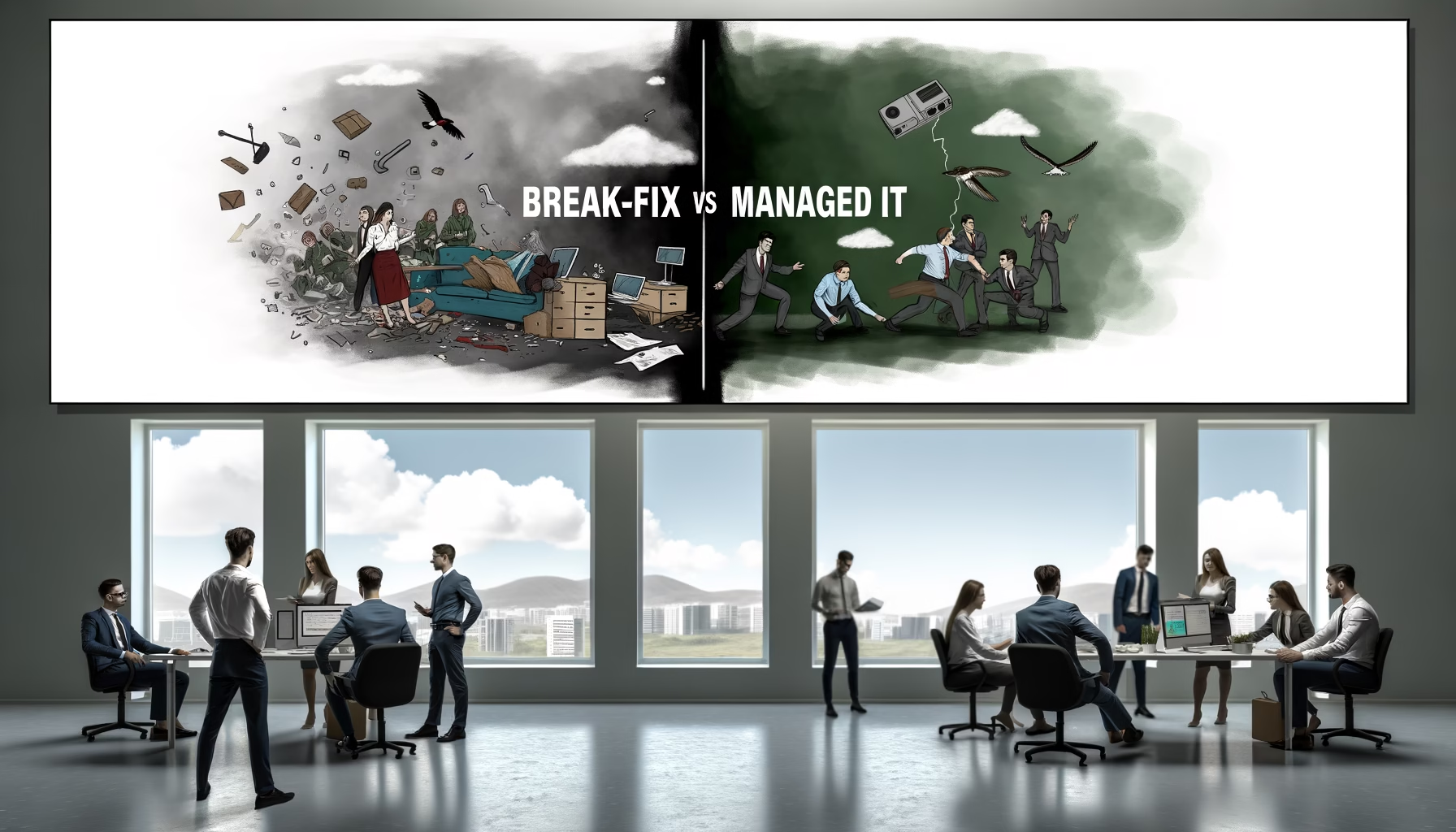
What Is Break-Fix IT and Why It Fails Growing Clearwater Businesses
Break-fix IT is the traditional model of technology support where you call a technician only after something goes wrong. For growing businesses in Clearwater and across the Tampa Bay region, this reactive approach creates mounting risks—from unpredictable costs to dangerous security gaps that leave your company exposed to modern cyber threats.
As your organization scales, the cracks in break-fix support widen. Hidden expenses accumulate through emergency service calls, lost productivity, and the opportunity cost of waiting for repairs instead of driving revenue. We’ve seen this pattern play out repeatedly at client sites across Tampa Bay: what starts as an affordable IT solution becomes a serious liability as your business matures.
The Break-Fix Model Explained
Under the break-fix model, you pay only when something breaks. There’s no ongoing relationship with your IT provider, no preventative maintenance schedule, and no continuous monitoring of your systems. Your technology infrastructure essentially runs without a safety net.
When a server crashes at 2 PM on a Tuesday, you pick up the phone, call a technician, and wait. Emergency service calls drive costs up significantly—often two to three times the rate of planned maintenance. According to CompTIA’s IT Industry Outlook, businesses relying solely on reactive IT support spend an average of 50% more on technology annually than those with proactive managed services.
The fundamental problem is simple: break-fix IT treats symptoms, not causes. The same issues recur because no one is looking at the root problems in your infrastructure.
Why It Works for Startups (But Not for Growth)
When you’re a five-person startup with a handful of laptops and a cloud email account, break-fix makes sense. Your IT needs are minimal, your budget is tight, and the risk of a major outage is relatively low. The lower initial costs appeal to new businesses trying to conserve cash.
But as your team grows beyond 15 to 20 employees, your technology complexity multiplies. You add line-of-business applications, handle more customer data, and depend on uptime for revenue generation. Businesses in Lakeland and Land O’ Lakes report the same growth challenges—the moment operations scale, break-fix support becomes unsustainable. The reactive model simply cannot keep pace with the demands of a growing organization.
Sign #1: Your IT Emergencies Are Becoming More Frequent and Costly
Clearwater businesses typically experience a tipping point when IT emergencies shift from occasional inconveniences to regular disruptions. If you’re fielding two or more emergency IT calls per month, your organization has likely outgrown the break-fix model. Learn more about break-fix IT vs. managed services cost comparison.
Escalating incident frequency is the clearest indicator that your technology infrastructure needs proactive management rather than reactive patching. Each emergency call represents not just a direct repair cost, but also the opportunity cost of stalled operations, frustrated employees, and potentially lost customers.
How to Calculate Your Real Break-Fix Costs
Most business owners underestimate what break-fix IT actually costs them. To get a clear picture, track every emergency service call over a six-month period. Include the technician’s invoice, but don’t stop there.
Calculate the lost productivity during each outage. If 20 employees can’t work for two hours, that’s 40 hours of lost productivity. Multiply that by your average hourly labor cost. Then estimate the revenue impact—sales that didn’t happen, deadlines that slipped, clients who waited.
When you total these figures and compare them against the predictable monthly cost of managed IT services, the math almost always favors the switch. The U.S. Small Business Administration recommends that small businesses allocate 6-7% of revenue to technology, but break-fix spending often exceeds this threshold unpredictably.
Why Preventative Monitoring Saves Money
Managed IT services detect issues before they become emergencies. Through 24/7 monitoring tools, your managed service provider (MSP) can identify a failing hard drive, a misconfigured firewall, or an expiring security certificate days or weeks before it causes a disruption.
This proactive approach reduces emergency service calls by up to 80%, according to industry benchmarks. Your IT budget becomes predictable, and your technology team—whether internal or outsourced—can focus on growth initiatives rather than constantly fighting fires. That’s the core difference when evaluating break-fix vs managed IT: one model reacts to problems, while the other prevents them.
Sign #2: You’re Losing Productivity to Downtime and IT Problems
Businesses in Clearwater lose an estimated tens of thousands of dollars annually to unplanned IT downtime. If your team regularly experiences slow systems, application crashes, or network outages that interrupt their workday, your current IT support model is costing you far more than you realize.
Downtime doesn’t just affect the person sitting at the broken computer. It cascades across departments, delays projects, and erodes the trust your customers place in your ability to deliver reliably.
The Hidden Cost of Downtime
Research from Gartner estimates that the average cost of IT downtime is approximately $5,600 per minute for mid-sized businesses. Even if your organization operates at a fraction of that figure, the numbers add up fast.
Consider the hours your employees spend each week waiting for IT fixes, rebooting systems, or working around broken tools. Customer-facing systems that go down translate directly to lost sales. Data from regional business surveys suggests that Tampa Bay firms average four to five unplanned outages per year—each one chipping away at your bottom line and your team’s morale.
Staff frustration is another hidden cost. When your best employees deal with constant IT headaches, they become less engaged—and more likely to look for opportunities at companies with better technology infrastructure.
How Managed IT Prevents Service Interruptions
A qualified MSP deploys 24/7 monitoring and alerting systems that catch anomalies in real time. Before a small issue becomes a company-wide outage, your managed IT provider has already identified and addressed it.
Most managed IT contracts include 99.9% uptime service level agreements (SLAs), giving you a contractual guarantee of system availability. Redundancy and backup systems come standard, and proactive maintenance happens during off-hours so your team never notices. These MSP benefits extend beyond just keeping the lights on—they create a stable platform for your business to grow confidently.

Sign #3: Your IT Budget Is Unpredictable and Out of Control
Clearwater CFOs and business owners consistently report that IT budget volatility is one of their top operational pain points. If your monthly IT spending swings wildly from one month to the next, you’ve outgrown the break-fix model.
Unpredictable expenses make it nearly impossible to forecast accurately, plan for growth, or allocate resources strategically. Leadership teams that can’t anticipate IT costs find themselves making reactive financial decisions that compromise long-term planning.
Break-Fix Cost Volatility vs. Managed IT Predictability
Under a break-fix arrangement, your monthly IT costs can vary from $500 in a quiet month to $10,000 or more when a major system fails. A single server crash or ransomware incident can blow through your entire quarterly IT budget overnight.
Managed IT services, by contrast, operate on a fixed monthly cost. You know exactly what you’ll spend on IT support every month, regardless of how many issues arise. There are no surprise invoices, no emergency surcharges, and no anxiety about what the next repair bill will look like. This predictability is one of the most immediately tangible MSP benefits for growing organizations.
ROI of Switching to Predictable IT Spending
Businesses that transition from break-fix to managed IT typically see a 30-40% reduction in total IT costs within the first year. This savings comes from eliminating emergency service premiums, reducing downtime, and catching small problems before they become expensive ones.
Predictable IT expenses also improve cash flow management. When you know your exact monthly technology costs, you can plan expansions, hire staff, and invest in business development with greater confidence. Many businesses across Pinellas County have redirected their IT savings into revenue-generating initiatives that accelerated their growth.
Sign #4: You Lack Proactive Security and Compliance Measures
Clearwater businesses handling sensitive customer data—especially in healthcare, financial services, and retail—face significant regulatory requirements that break-fix IT simply cannot address. If your current IT support doesn’t include continuous security monitoring, regular compliance audits, and employee security training, your organization is exposed to both cyber threats and regulatory penalties.
This is where the break-fix model poses its most dangerous limitation. Security isn’t something you can fix after the fact—by the time a breach occurs, the damage is done.
Why Break-Fix IT Can’t Protect You from Modern Threats
Break-fix providers respond to security incidents after they happen. There’s no continuous monitoring for breaches, no regular patching schedule, and no proactive threat detection. Your staff likely hasn’t received training on phishing, social engineering, or data protection best practices.
The Cybersecurity and Infrastructure Security Agency (CISA) has repeatedly warned that small and mid-sized businesses are increasingly targeted by ransomware and phishing campaigns because attackers know these organizations often lack adequate defenses. The Tampa Bay region has seen a dramatic increase in cyber attacks targeting growing businesses, with ransomware, business email compromise, and credential theft leading the threat landscape.
Florida businesses must also navigate state-level data protection requirements. The Florida Information Protection Act (FIPA) requires organizations to notify affected individuals within 30 days of a data breach—and the fines for non-compliance can be substantial. HIPAA-covered entities in the Clearwater healthcare corridor and PCI-DSS-regulated retailers face even stricter requirements.
How Managed IT Services Include Security and Compliance
A comprehensive managed IT service includes continuous threat monitoring and detection, endpoint detection and response (EDR), multi-factor authentication (MFA) management, and regular security patches applied across all systems. These aren’t add-ons—they’re built into the service model.
Employee security awareness training is another critical component. Your team learns to recognize phishing emails, avoid social engineering traps, and follow data handling best practices. Regular simulated phishing exercises reinforce this training over time.
For compliance-driven organizations, managed IT providers maintain audit trails, generate compliance reports, and ensure your systems meet the requirements of HIPAA, PCI-DSS, and Florida data protection regulations. At Virtual IT Group, our Microsoft Partner and CompTIA Partner credentials give clients confidence that their security and compliance posture meets the highest industry standards. You can learn about our security and compliance solutions to see how these protections work in practice.

Sign #5: You’re Unable to Scale IT Resources With Business Growth
Clearwater businesses experiencing rapid growth often find that their break-fix IT provider simply cannot keep up. If adding new employees takes days instead of hours, if opening a second location creates IT chaos, or if supporting remote workers feels impossible, your IT support model is holding your business back.
Scalability is one of the defining advantages of managed IT over break-fix support. Your technology infrastructure should enable growth, not constrain it.
The Scalability Problem With Break-Fix Support
Hiring an internal IT staff member costs $80,000 or more annually in the Tampa Bay market—and a single technician can only cover so much ground. Break-fix vendors can’t guarantee consistent support quality during rapid growth periods because they staff to their overall client base, not your specific needs.
Onboarding new users, deploying equipment, and configuring access becomes painfully slow without standardized processes. When you open a new office or shift to a hybrid work model, multi-location support under a break-fix arrangement becomes unmanageable. Every new endpoint, every remote connection, and every additional application increases complexity that break-fix IT wasn’t designed to handle.
Why Managed IT Scales With Your Business
Managed IT services provide flexible scaling of IT resources without the overhead of hiring. Whether you’re adding five employees or fifty, your MSP adjusts support capacity seamlessly. The quality of service remains consistent regardless of company size.
Remote work support, multi-location management, and distributed team infrastructure are built into the managed IT model. Your provider also develops a technology roadmap aligned with your business plan—anticipating your IT needs six to twelve months before they arise.
Companies in Dunedin and Land O’ Lakes have leveraged MSP scalability to expand operations without the delays and disruptions that break-fix clients routinely experience. When your IT support Tampa partner grows with you rather than reacting to you, the entire trajectory of your business changes.
Local Angle: How Clearwater and Tampa Bay Businesses Are Making the Switch
The Tampa Bay region is experiencing robust business growth, creating IT capacity challenges that break-fix support was never designed to handle. Companies across Pinellas County are increasingly recognizing that reactive IT support is a competitive disadvantage in a market that rewards speed, reliability, and security.
Remote and hybrid work policies, which expanded dramatically across the region, require modern IT infrastructure that break-fix providers struggle to deliver. Combine that with an intensifying cyber threat landscape affecting Florida businesses of all sizes, and the case for managed IT becomes overwhelming.
Virtual IT Group has served the Tampa Bay region for over 40 years, helping organizations of every size transition from reactive IT support to proactive, security-focused managed services. Our team understands the unique challenges facing businesses in this market—from compliance requirements in the Clearwater healthcare corridor to the multi-site management demands of growing professional services firms. You can see how Virtual IT Group helps Tampa Bay businesses navigate these transitions successfully.
Why Now Is the Right Time for Clearwater Businesses
The Tampa Bay region is experiencing significant year-over-year business growth, and companies that invest in reliable IT infrastructure now position themselves for a competitive advantage. Post-pandemic remote work expectations aren’t going away—they’re becoming a baseline requirement for attracting and retaining talent.
Meanwhile, the cyber threat landscape continues to intensify. Florida businesses face unique risks due to the state’s large healthcare, tourism, and financial services sectors—all of which are prime targets for cybercriminals. Investing in managed IT with integrated security isn’t just a smart business move. For many Clearwater organizations, it’s becoming a survival requirement.
Key Takeaways
- Break-fix IT is a reactive model that becomes unsustainable as your Clearwater business grows beyond its startup phase, leading to escalating costs and security risks.
- Frequent IT emergencies and rising costs are the earliest warning sign that you’ve outgrown break-fix support—track your real costs including downtime and lost productivity.
- Budget unpredictability undermines growth planning. Managed IT provides fixed monthly costs that allow you to forecast accurately and invest confidently in your business.
- Cybersecurity and compliance cannot be handled reactively. Modern threats require continuous monitoring, endpoint protection, MFA, and employee training—none of which break-fix provides.
- Scalability is a defining MSP benefit. Managed IT grows with your business, supporting new employees, locations, and remote workers without the delays and disruptions of break-fix.
- Tampa Bay businesses making the switch typically see 30-40% IT cost reductions, dramatically fewer outages, and stronger security postures within the first year.
Frequently Asked Questions
How much does managed IT services cost in Clearwater compared to break-fix?
Managed IT services in Clearwater typically cost between $100 and $300 per user per month, depending on the scope of services included. Break-fix support, by contrast, averages $150 to $400 or more per incident with no cost predictability. Most Clearwater businesses see 25-40% total cost savings within the first year of switching to managed IT when they account for downtime elimination, reduced emergency calls, and avoided security incidents. The key financial advantage is predictability—you know exactly what IT will cost every month, making budgeting and growth planning far more reliable.
Can we switch to managed IT without disrupting our current operations?
Yes, and this is one of the most common concerns we hear from business owners considering the transition. Professional MSPs like Virtual IT Group plan migrations carefully to minimize downtime and operational impact. The process typically begins with a thorough discovery phase where we document your current systems, identify vulnerabilities, and create a detailed migration plan. The actual transition is scheduled during off-hours or weekends, and your team receives clear communication at every step so they know what to expect. Most businesses experience little to no disruption during the switch.
What happens if our managed IT provider goes out of business?
This is a valid concern, which is why choosing a stable, established MSP matters. Reputable managed IT providers maintain strict data backup and disaster recovery protocols that ensure your information is always accessible and recoverable. Contracts with quality MSPs include provisions for service continuity and data transfer in any scenario. Virtual IT Group’s 40-year history serving the Tampa Bay area provides the stability and proven track record that growing businesses need. We recommend always verifying your provider’s financial stability, client retention rates, and contractual data portability guarantees before signing an agreement.
Is managed IT services right for smaller businesses in the Tampa Bay area?
Absolutely. In fact, managed IT is increasingly popular with growing companies across the Tampa Bay region, including smaller firms in Lakeland, Land O’ Lakes, and surrounding communities. Even teams of 10 to 50 people benefit significantly from predictable costs, proactive security, and the scalability that break-fix support cannot provide. Smaller businesses are often more vulnerable to cyber threats precisely because they lack dedicated IT security resources—making managed IT with integrated cybersecurity protection especially valuable. The per-user pricing model means you only pay for the support you need, scaling up as your team grows.
How does managed IT help with compliance in Florida?
Managed IT providers maintain the compliance documentation, security audit logs, and regulatory reporting required by Florida data protection laws including the Florida Information Protection Act (FIPA). For Clearwater businesses in healthcare, this means HIPAA-compliant infrastructure, access controls, and breach notification readiness. Financial services and retail organizations benefit from PCI-DSS compliance support, including secure payment processing environments and regular vulnerability assessments. Your managed IT provider handles the technical controls while providing the documentation and reporting you need to demonstrate compliance during audits. This integrated approach is something break-fix support simply cannot replicate.
Ready to Move Beyond Break-Fix IT in Clearwater?
If you recognized your business in any of these five warning signs, you’re not alone. Hundreds of Clearwater and Tampa Bay organizations have made the successful transition from break-fix to managed IT—and the results speak for themselves in reduced costs, stronger security, and faster growth.
Virtual IT Group offers a free 30-minute IT assessment for businesses ready to explore the switch. Our CompTIA and Microsoft-certified team will evaluate your current setup, identify your biggest risk areas, and show you a clear path to predictable, secure, and scalable IT support. Schedule your free assessment today and discover how much your business could save. Clearwater companies are already seeing the benefits—your business deserves the same advantage.
Want to learn more about what’s included? Explore our managed IT services to see the full scope of what proactive IT support looks like for growing businesses in the Tampa Bay region.