
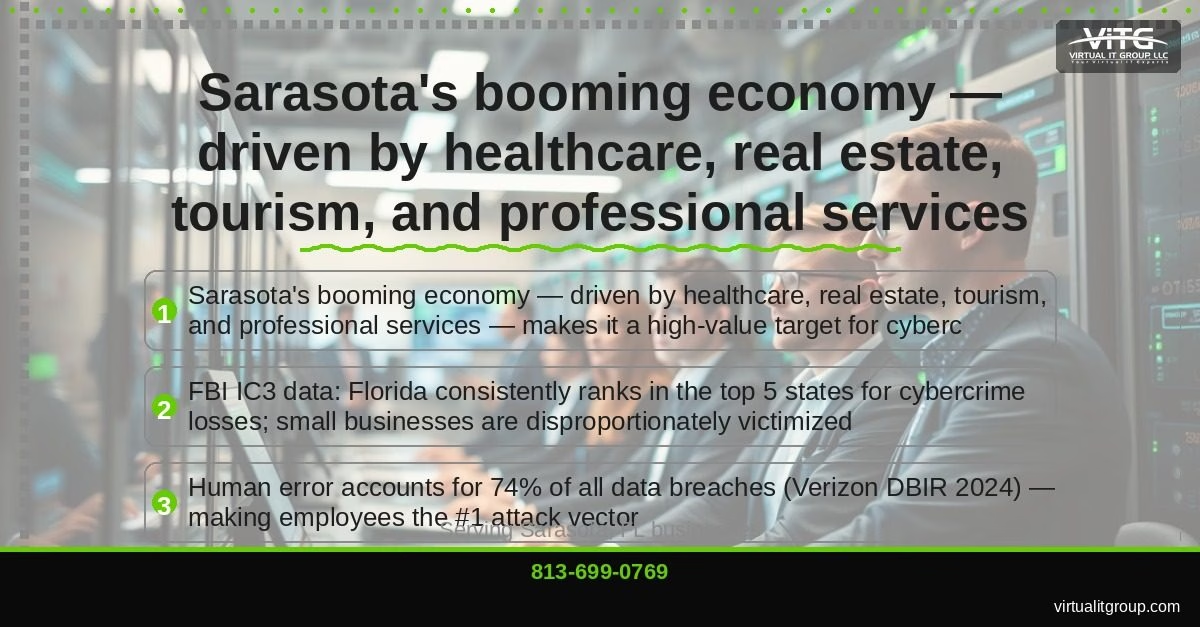
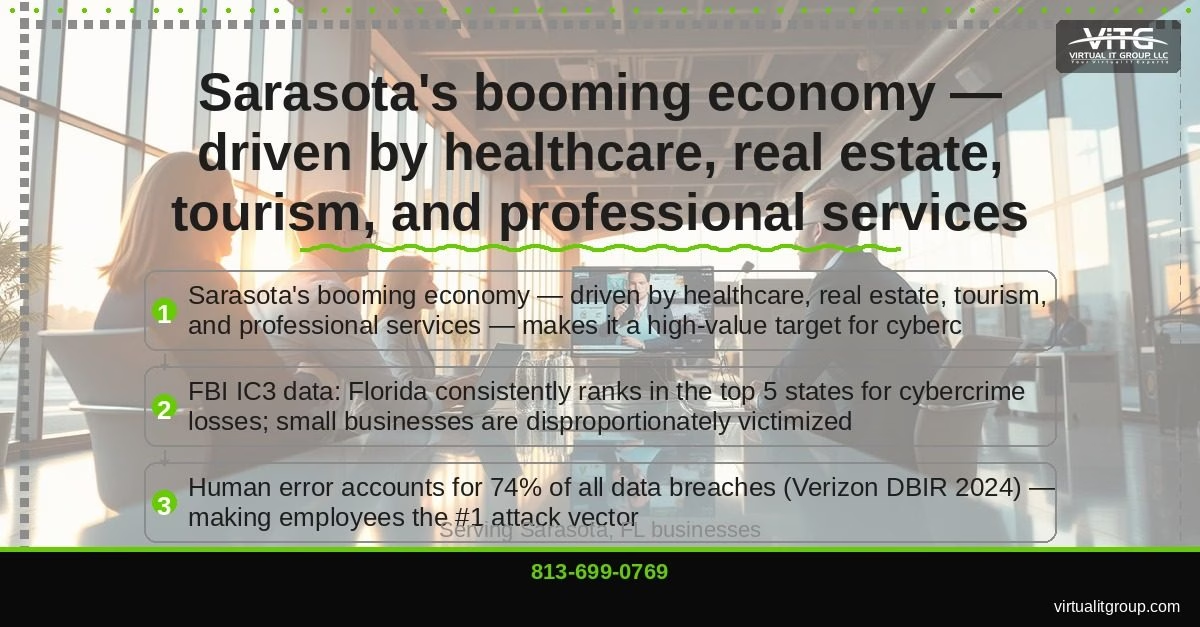
If your business operates in Sarasota County, here’s a number worth sitting with: 74% of all data breaches trace back to human error, not a firewall failure or a software vulnerability. That’s according to the Verizon Data Breach Investigations Report 2024. Your employees are the most targeted layer of your security stack — and in a market like Sarasota, where healthcare practices, real estate brokerages, and hospitality businesses handle sensitive financial and personal data every single day, that exposure is significant. Security Awareness Training (SAT) is the structured, ongoing education program that teaches your team to recognize phishing emails, social engineering attempts, ransomware lures, and other human-layer attacks before they cause damage. At Virtual IT Group, LLC, we’ve spent 20 years helping Tampa Bay businesses — including dozens across Sarasota County — build that human firewall. This guide covers what SAT is, who in Sarasota needs it most, what it costs, and what results you can realistically expect.
Last Updated: August 24, 2026
Why Are Sarasota Businesses Prime Targets for Phishing and Social Engineering Attacks?
Sarasota’s economy is a cybercriminal’s wish list. Healthcare, real estate, tourism, legal services, and financial advising all concentrate in a relatively compact metro area — and every one of those industries handles exactly what attackers want: wire transfer authority, protected health information, client financial records, and payment card data.
The FBI’s Internet Crime Complaint Center consistently ranks Florida in the top five states for total cybercrime losses. In 2023, Florida businesses and individuals reported over $874 million in losses. Small and mid-sized businesses absorb a disproportionate share of that damage, because they typically lack the dedicated security teams that larger enterprises maintain.
Here’s what makes Sarasota specifically attractive to attackers: the area’s real estate market (median home price above $450,000) means wire transfers happen constantly. A single Business Email Compromise (BEC) attack targeting a real estate closing can net an attacker $50,000 to $400,000 in a single transaction. Sarasota Memorial Health System and the dozens of physician groups and dental practices throughout the county are bound by HIPAA — but HIPAA compliance doesn’t automatically mean your front desk staff knows how to spot a credential-harvesting email disguised as an Epic patient portal notification.
Security Awareness Training (SAT) is a structured, ongoing education program that teaches employees to identify and report phishing emails, vishing calls, social engineering attempts, and other human-layer threats. It’s not a one-time lunch-and-learn. Effective SAT uses simulated phishing attacks, short role-based training modules, and measurable reporting metrics to change employee behavior over time.
I’ve been doing this for 20 years across Tampa Bay. The businesses that get hit hardest aren’t the ones with bad firewalls — they’re the ones whose employees never learned that a DocuSign request from an unknown sender isn’t automatically safe to click.
Key takeaway: Sarasota’s concentration of healthcare, real estate, and financial services businesses makes it a high-value target for phishing and BEC attacks, and human error accounts for 74% of breaches — making Security Awareness Training the most cost-effective defensive investment available to local SMBs.
What Is Security Awareness Training and How Does It Protect Sarasota Companies?
Security Awareness Training (SAT) is a structured, ongoing program that educates employees to identify phishing emails, social engineering tactics, ransomware delivery methods, and risky digital behaviors. Unlike a one-time seminar, an effective SAT program runs continuously — using simulated phishing campaigns, short micro-learning modules, and compliance dashboards to measure and improve employee behavior month over month.
The core components of a mature SAT program include:
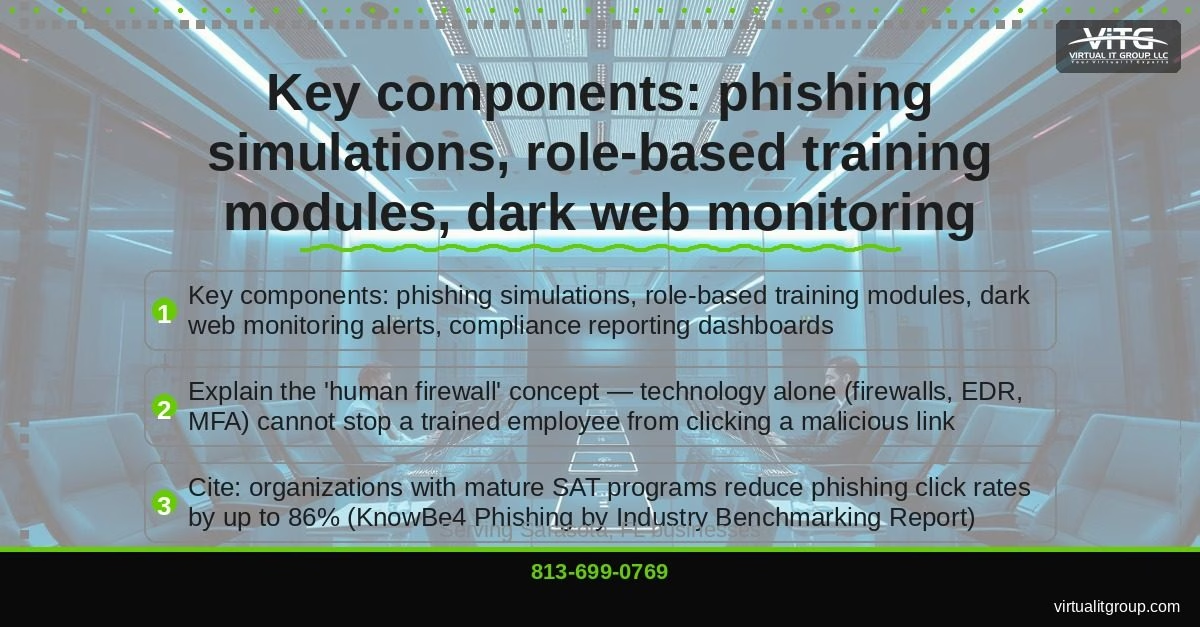
- Simulated phishing attacks: Realistic fake phishing emails sent to your team on a scheduled basis to test click rates and measure improvement
- Role-based training modules: Short (5-10 minute) video-based lessons assigned by job function — your finance team gets wire fraud and BEC modules; your reception staff gets vishing and social engineering content
- Dark web monitoring alerts: Notification when your employees’ credentials appear in known breach databases
- Compliance reporting dashboards: Monthly reports showing training completion rates, phishing click rates, and trend data — formatted for HIPAA, PCI-DSS, and cyber insurance audits
- Phish Alert Button: A one-click tool that lets employees report suspicious emails directly to your IT team for real-time review
The concept behind all of this is the “human firewall.” Technology — firewalls, endpoint detection and response (EDR), multi-factor authentication (MFA) — is essential, but none of it can stop a trained employee from voluntarily handing over credentials to a convincing fake login page. The KnowBe4 Phishing Industry Benchmarking Report found that organizations with mature SAT programs reduce phishing click rates by up to 86% within 12 months. That’s not a marginal improvement — that’s a fundamental shift in your risk profile.
For Sarasota businesses specifically, SAT also addresses compliance requirements that aren’t optional. HIPAA mandates workforce security training for healthcare providers. GLBA requires it for financial advisors and accountants. PCI-DSS demands it for any business processing payment cards — which covers most of Sarasota’s hospitality and retail sector.
If you’re not sure where your team currently stands on phishing awareness, call us at (813) 699-0769. We’ll run a baseline phishing simulation at no cost so you can see your actual click rate before committing to anything.
Key takeaway: Security Awareness Training is a continuous, measurable program — not a one-time event — that uses simulated phishing, role-based modules, and compliance reporting to reduce human-layer breach risk by up to 86%, while satisfying HIPAA, GLBA, and PCI-DSS training requirements.
Which Sarasota Industries Need Security Awareness Training the Most?
Every business with employees and email needs SAT. But some Sarasota industries carry concentrated risk that makes training especially urgent.
Healthcare and Medical Practices: Sarasota Memorial Health System, physician groups throughout Palmer Ranch and Lakewood Ranch, dental practices, and behavioral health providers all handle protected health information (PHI) daily. Ransomware attacks on healthcare organizations surged 264% between 2018 and 2023, according to the HHS Office for Civil Rights. HIPAA’s Security Rule explicitly requires covered entities to implement security awareness and training programs — not as a best practice, but as a legal requirement.
Real Estate and Property Management: Wire fraud is the single biggest financial threat to Sarasota’s real estate sector. Attackers monitor email threads between agents, title companies, and buyers, then send a spoofed email at closing with fraudulent wire instructions. The average BEC loss per incident nationally is $125,000 — but in Sarasota’s market, a single residential closing wire can exceed that. Your agents need to recognize the signs of a compromised email thread before they forward wiring instructions to a client.
Hospitality and Tourism: Siesta Key, St. Armands Circle, and downtown Sarasota’s restaurant and hotel corridor process enormous volumes of payment card data. POS system compromises often begin with a phishing email to a manager-level employee. Training your front-of-house and back-office staff to recognize suspicious emails is the first line of defense against a PCI-DSS breach that could cost you your ability to accept credit cards.
Professional Services (Law, Accounting, Finance): Law firms and CPA practices in Sarasota hold client financial records, tax data, and confidential legal communications. State bar rules and GLBA both carry compliance obligations around data protection. One successful phishing attack on a paralegal’s email account can expose an entire client portfolio.
Nonprofits and Arts Organizations: Sarasota Opera, the Ringling Museum, and dozens of smaller arts nonprofits are frequently under-resourced for IT security. Attackers know this and specifically target nonprofits with gift card scams and fake vendor invoice requests — both of which are entirely preventable with basic SAT.
Construction and Contractors: As Sarasota’s development market stays active, contractors are increasingly targeted through invoice fraud. A subcontractor receives what looks like a standard payment request from a general contractor — except the bank account number has been changed. This is a classic BEC scenario that SAT directly addresses.
We serve clients across all of these industries from Sarasota proper through Dover, Gibsonton, and Dade City. The threats are consistent; the training content is customized by industry and role.
Key takeaway: Sarasota’s healthcare, real estate, hospitality, and professional services sectors face specific, high-dollar cyber threats — including ransomware, BEC wire fraud, and POS compromises — that Security Awareness Training directly reduces through role-specific employee education.
How Does Virtual IT Group Deliver Security Awareness Training to Sarasota Businesses?
I’ll be honest — when I first started building out our SAT program years ago, I assumed the technology platform was the hard part. Turns out the harder part is getting employees to take a 7-minute training module seriously when they’re already juggling a full inbox. The program design has to account for that reality, or your completion rates crater and the data is useless.
Here’s exactly how we deliver SAT to Sarasota and Tampa Bay clients:
- Baseline Phishing Assessment: Before any training begins, we send a simulated phishing campaign to your entire team. No warning, no prep. This gives us your actual baseline click rate — the percentage of employees who would have clicked a malicious link. Across our new clients, we typically see baseline click rates between 28% and 41%. That number is sobering, and it’s the most effective way to get leadership buy-in for the program.
- Customized Training Rollout: Based on your industry and employee roles, we assign specific training modules. Your finance team gets BEC and wire fraud content. Your reception and admin staff get vishing (phone-based social engineering) and physical security modules. Executives get targeted spear-phishing awareness. Each module runs 5-10 minutes and is delivered through a cloud-based platform — no software installation, no disruption to your operations.
- Monthly Simulated Phishing Campaigns: We run ongoing simulated attacks using real-world templates: IRS refund notices, Microsoft 365 password reset requests, DocuSign signature requests, FedEx delivery alerts. The templates rotate monthly so employees can’t pattern-match and ignore the exercise. Employees who click receive immediate, non-punitive micro-training that explains what they missed.
- Reporting and Compliance Dashboard: Every month, you receive a report showing click rates by department, training completion percentages, and trend data over time. This report is formatted to satisfy HIPAA audit requirements, cyber insurance documentation requests, and PCI-DSS compliance reviews. A 35-person professional services firm in the Sarasota area reduced their phishing click rate from 34% to under 4% within 90 days of starting our program — that data was directly submitted to their cyber insurer for a premium review.
- Phish Alert Button and SOC Review: Employees get a one-click button in their email client to report suspicious messages. Our Security Operations Center reviews flagged emails in real time, which means a genuine threat reported by one employee gets neutralized before it reaches the rest of your team.
The program is fully remote to onboard — no site visit required, though we’re happy to come to your Sarasota office. We serve clients from downtown Sarasota through Dade City, Dover, and Gibsonton without any disruption to your day-to-day operations.
Ready to see your baseline click rate? Call (813) 699-0769 and we’ll schedule your no-cost phishing assessment this week.
Key takeaway: Virtual IT Group delivers Security Awareness Training through a five-step process — baseline assessment, role-based rollout, monthly simulated phishing, compliance reporting, and real-time SOC review — with full remote onboarding and no operational disruption for Sarasota businesses.
What Does Security Awareness Training Cost — and What’s the ROI for a Sarasota Small Business?
The cost question is the right one to ask. Here are the numbers.
A managed SAT program typically runs $5 to $25 per employee per month, depending on the platform, the level of customization, and whether compliance reporting is included. For a 20-person Sarasota business, that’s $100 to $500 per month — or $1,200 to $6,000 annually. Most of our Tampa Bay clients with 15 to 50 employees land in the $150 to $350 per month range for a fully managed program.
Now compare that to the cost of a breach. The IBM Cost of a Data Breach Report 2023 puts the average breach cost for SMBs at $4.45 million globally. Florida adds a specific legal layer on top of that: the Florida Information Protection Act (FIPA) requires breach notification within 30 days and carries penalties up to $500,000 for non-compliance. A single prevented wire fraud attempt — average BEC loss is $125,000 per incident — covers years of SAT program costs.
The ROI case isn’t abstract. A Sarasota-area professional services firm that came to us was running no formal SAT program. Their baseline phishing click rate was 34%. Within 90 days of enrolling in our program, that rate dropped to under 4%. Their cyber insurance carrier, upon seeing the documented improvement, initiated a premium review. The training program paid for itself in the first year before accounting for any prevented incident.
There’s also the insurance angle. Cyber insurance carriers are increasingly requiring documented SAT programs as a condition of coverage — not just a discount qualifier, but an eligibility requirement. If you can’t show a carrier that your employees receive regular phishing simulations and security training, you may find your policy non-renewed at the next cycle. Virtual IT Group provides all the documentation your broker needs.
“Technology should be an accelerator for your business, not a constant source of frustration. If your team is complaining about IT more than once a week, something is fundamentally broken in your IT strategy.” — Brian Truman, CEO, Virtual IT Group
The same logic applies to security. If your employees are clicking phishing links, your security strategy has a gap that no firewall closes.
Key takeaway: Security Awareness Training costs $5-$25 per employee per month — a fraction of the $4.45 million average breach cost or the $125,000 average BEC loss — and is increasingly required by cyber insurance carriers as a condition of coverage, making it both a risk reduction and a financial protection investment.
Frequently Asked Questions About Security Awareness Training in Sarasota
How long does it take to see results from Security Awareness Training?
Most Sarasota businesses see measurable phishing click rate reductions within 60 to 90 days of starting a managed SAT program. The KnowBe4 benchmarking data shows that organizations drop from an average baseline click rate of 32.4% to under 5% within 12 months of continuous training. The first simulated phishing campaign after training typically shows the sharpest improvement — employees who just completed a module on recognizing phishing signs are actively applying that knowledge.
Is Security Awareness Training required for HIPAA compliance in Florida?
Yes. The HIPAA Security Rule (45 CFR §164.308(a)(5)) requires covered entities and business associates to implement a security awareness and training program for all workforce members. This isn’t optional. The HHS Office for Civil Rights has cited inadequate workforce training in numerous enforcement actions. For Sarasota healthcare practices, documented SAT completion records are a standard audit requirement.
What’s the difference between Security Awareness Training and a phishing test?
A phishing test is a single simulated attack that measures your employees’ current susceptibility. Security Awareness Training is the ongoing program that includes phishing simulations, structured training modules, reporting metrics, and behavioral reinforcement over time. Running a phishing test without a training program attached is like measuring your blood pressure without treating it — useful data, but incomplete as a health strategy.
Can small businesses in Sarasota afford Security Awareness Training?
Yes. Most Sarasota SMBs with 10 to 50 employees pay $150 to $400 per month for a fully managed SAT program through Virtual IT Group. That includes simulated phishing campaigns, role-based training modules, compliance reporting, and SOC review of reported emails. For context, the average BEC wire fraud loss in Florida is $125,000 per incident — one prevented attack covers roughly 25 years of program costs at the $400/month rate.
Do employees in Sarasota’s remote or hybrid offices need Security Awareness Training?
Remote and hybrid employees are actually at higher risk than in-office staff, because they’re working outside the network perimeter and often on personal devices. Our SAT program is entirely cloud-based and delivers the same training, phishing simulations, and reporting regardless of where your team works. We serve remote employees across Sarasota County, Dover, Gibsonton, Dade City, and throughout the Tampa Bay region without any on-site requirement.
If your Sarasota business hasn’t run a phishing simulation in the last 90 days, you don’t actually know your current risk exposure. I’ve seen this across 20 years of serving Tampa Bay businesses — the companies that get hit hardest are almost always the ones that assumed their employees “would know better.” They don’t, until they’re trained to.
Virtual IT Group, LLC is ready to run your baseline phishing assessment, build a training program matched to your industry and team structure, and give you the compliance documentation your insurer and auditors require. Call us at (813) 699-0769 or visit virtualitgroup.com to schedule a no-obligation assessment. We serve Sarasota, Dover, Gibsonton, Dade City, and businesses throughout the Tampa Bay Gulf Coast region.
Virtual IT Group, LLC | (813) 699-0769 | virtualitgroup.com