

If your Dunedin office is running on a tangle of unlabeled cables stuffed into a closet, you’re not alone — and you’re not just dealing with an eyesore. That wiring is actively costing you money. Structured cabling is the organized, standards-based physical network infrastructure that connects every device in your office: computers, phones, cameras, access control systems, and everything in between. For Dunedin businesses operating out of the historic downtown buildings along Main Street or the marina district, the gap between what’s in the walls and what modern operations demand is often significant. According to BICSI and Gartner research, 70% of network failures originate at the physical layer — meaning the cabling itself, not the firewall, not the cloud provider, not the router. I’ve seen this play out dozens of times across Pinellas County in my 20 years with Virtual IT Group, LLC. The good news: it’s a fixable problem, and the ROI is immediate.
Last Updated: September 16, 2026
Why Does Structured Cabling Matter for Dunedin Businesses?
TL;DR: Poor cabling infrastructure causes network downtime, slow speeds, and security gaps. Dunedin’s older commercial buildings are especially vulnerable. Professional structured cabling eliminates these problems at the source.
Dunedin has a charming stock of historic commercial buildings — which is great for foot traffic and character, and genuinely problematic for network infrastructure. Many of those buildings were wired decades ago with Cat3 or early Cat5 cable, designed for phone systems and early internet connections running at a fraction of today’s bandwidth demands. Your team is now running video calls, cloud-based EHR or accounting software, VoIP phones, and Wi-Fi access points — all on infrastructure that was never designed for it.
The result is what I call “spaghetti wiring”: unlabeled runs, mixed cable grades, no patch panel documentation, and ports that nobody knows are live. That last part matters more than most business owners realize. An unlabeled, live network port in a conference room or back office is an open door. Anyone who plugs in can potentially access your network. That’s not a hypothetical — it’s a compliance violation waiting to happen for any Dunedin business in healthcare, legal, or financial services.
Virtual IT Group, LLC has served Tampa Bay and Pinellas County businesses for 20 years. The structured cabling problems we find in Dunedin offices are consistent: aging cable grades, no documentation, and zero testing records. We fix all three.
Key takeaway: 70% of network failures trace back to physical layer cabling issues, and Dunedin’s older commercial building stock makes local businesses disproportionately exposed to this risk.
How Does Dunedin’s Local Business Climate Make Network Infrastructure a Competitive Advantage?
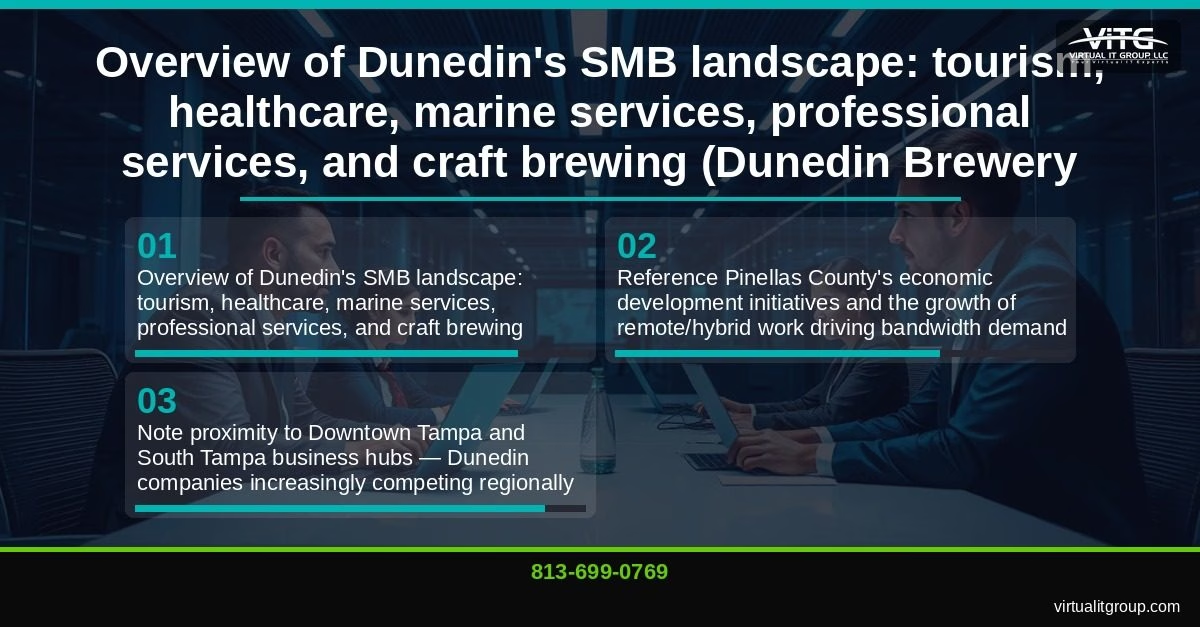
Pinellas County had over 47,000 registered businesses as of 2023, according to the Pinellas County Economic Development office. Dunedin’s slice of that includes tourism-adjacent retail, healthcare practices, marine services, professional services firms, and a growing craft beverage and hospitality scene around the Dunedin Brewery area. These aren’t industries with identical IT needs — but they share one requirement: reliable, fast connectivity.
Here’s what I’ve noticed over the past few years: Dunedin businesses that compete regionally against firms in Westchase or South Tampa are often running on infrastructure that’s two generations behind. A professional services firm in Westchase that built out its office five years ago likely has Cat6A drops, a properly documented patch panel, and 10Gbps-ready backbone. Your Dunedin counterpart, operating out of a renovated building near the Pinellas Trail, may be on Cat5e that someone ran in 2008 with no testing records.
That gap shows up in real ways: slower file transfers, dropped VoIP calls, video conferencing that freezes at the worst moments, and Wi-Fi dead zones because access points can’t get adequate throughput from the cable feeding them. Remote and hybrid work has made this worse — your team’s experience on a home gigabit connection sets an expectation that your office network now has to meet.
Structured cabling is also a prerequisite for the systems Pinellas County businesses increasingly depend on: VoIP phone systems, cloud services with high data throughput requirements, IP-based video surveillance, and electronic access control. You can’t bolt those onto bad cable and expect them to perform. Florida’s commercial spaces must also comply with TIA-568 cabling standards and NEC Article 800 for plenum-rated cable — requirements that DIY or unqualified installations routinely miss.
If you’re wondering whether your current setup is holding your team back, call us at (813) 699-0769 — a quick conversation usually tells us a lot about what’s going on in your infrastructure.
Key takeaway: Dunedin SMBs competing regionally are often disadvantaged by legacy cabling that limits VoIP, cloud performance, and modern security systems — structured cabling closes that gap directly.
What Is Structured Cabling and What Does a Professional Installation Actually Include?
Structured cabling is a standardized approach to building a physical network infrastructure using a defined set of subsystems, governed by TIA-568, TIA-606, and ANSI standards. It’s the opposite of running cables wherever they fit and hoping for the best.
A complete structured cabling system has six subsystems:
- Entrance Facilities: Where the outside network (ISP, fiber) enters your building.
- Equipment Rooms: The central hub housing your core networking gear — switches, patch panels, UPS systems.
- Backbone Cabling: The high-capacity runs connecting equipment rooms to telecommunications rooms on different floors or in different buildings.
- Telecommunications Rooms (IDFs): Intermediate distribution frames serving specific zones or floors.
- Horizontal Cabling: The individual runs from the IDF to each work area — this is where cable grade matters most.
- Work Area Components: The wall plates, patch cables, and connections at each desk or device location.
Cat6 vs. Cat6A: which does your Dunedin office need? Cat6 supports 10Gbps up to 55 meters and is sufficient for most small offices. Cat6A supports 10Gbps up to 100 meters and handles higher crosstalk environments better — it’s the right choice for any run longer than 55 meters, any environment with significant electrical interference, or any office that wants to be ready for the next decade without recabling. Most Dunedin offices under 5,000 square feet can use Cat6 effectively; larger or multi-floor spaces should seriously consider Cat6A.
I’ll be honest — I used to default to Cat6 for most small office projects to keep costs down. Over time, I’ve shifted toward recommending Cat6A more often, because the labor cost of recabling in three years when a client upgrades their switches exceeds the upfront cable cost difference every single time.
For multi-floor or multi-building Dunedin campuses (think a marina-adjacent business with a separate warehouse or storage building), fiber optic backbone cabling is the right answer for the backbone runs. Fiber is immune to electromagnetic interference, supports much longer distances, and future-proofs the connection between buildings.
Every cable run we install gets tested and certified with a Fluke DSX cable analyzer. You receive the full test report as part of your project documentation — not just our word that it works, but a certified record of every run’s performance. That documentation matters for insurance purposes, future troubleshooting, and any regulatory audit.
One practical note specific to Florida: the heat and humidity in Pinellas County affect your network closet environment. Proper IDF design includes adequate ventilation and, where necessary, dedicated cooling. Plenum spaces above drop ceilings require CMP-rated cable per NEC Article 800 — a code requirement that non-specialist installers frequently miss, and that can create liability during a Pinellas County building inspection.
A Dunedin medical practice we worked with recently upgraded from Cat5e to Cat6A across 28 drops to support their EHR system and a new telemedicine platform. The Cat5e runs were failing intermittently under load — the kind of failure that’s nearly impossible to diagnose without proper testing equipment. After the upgrade and certification, their EHR performance issues disappeared entirely.
Key takeaway: Professional structured cabling follows TIA-568 standards across six defined subsystems, uses Fluke DSX-certified testing on every run, and accounts for Florida-specific requirements like CMP-rated plenum cable — none of which a generic electrician or DIY installation reliably delivers.
How Does Structured Cabling Support Cybersecurity and Compliance for Dunedin SMBs?
Most business owners think about cybersecurity in terms of firewalls, antivirus, and phishing training. The physical layer rarely comes up — which is exactly why it’s an underappreciated vulnerability.
Shadow ports are live, undocumented network ports that exist in your office because nobody tracked what was installed or what was decommissioned. They’re common in buildings that have been through multiple tenants or renovation projects. A shadow port in a conference room, lobby, or break room gives anyone with a cable physical access to your network — bypassing every logical security control you’ve invested in.
The IBM Cost of a Data Breach Report 2023 put the average breach cost at $4.45 million. For a Dunedin SMB, even a fraction of that cost — regulatory fines, notification requirements, business interruption — is catastrophic. Florida’s Information Protection Act (FIPA) adds state-level breach notification requirements on top of federal frameworks like HIPAA and PCI-DSS.
Proper structured cabling directly supports your cybersecurity posture in three concrete ways:
- Physical network segmentation: Properly documented and terminated cabling makes VLAN implementation clean and reliable. You can separate guest Wi-Fi, point-of-sale systems, and internal workstations at the physical layer — not just in software.
- Port accountability: Every run is documented and labeled. You know exactly which port is live, where it terminates, and what’s connected to it. No shadow ports.
- Audit-ready documentation: HIPAA, PCI-DSS, and SOC 2 auditors increasingly ask for network infrastructure documentation. A certified cabling report from a Fluke DSX analyzer is a credible, professional response.
As someone holding a CompTIA Security+ certification alongside 20 years of hands-on network work, I can tell you that the physical layer is consistently underweighted in SMB security assessments. The NIST Cybersecurity Framework and CIS Controls both include physical security as foundational — and that starts with knowing what’s in your walls.
If your Dunedin practice or professional services firm is subject to HIPAA, FIPA, or PCI-DSS, your cabling infrastructure is part of your compliance story. Call us at (813) 699-0769 to talk through what a network infrastructure review looks like for your specific regulatory environment.
Key takeaway: Unmanaged cabling creates shadow ports and undocumented access points that violate HIPAA, PCI-DSS, and Florida FIPA requirements — professional structured cabling eliminates these vulnerabilities and produces the documentation auditors require.
What Does Virtual IT Group’s Structured Cabling Process Look Like for Dunedin Business Owners?
Here’s exactly what working with us looks like, from first call to finished installation:

- Free on-site assessment: We come to your Dunedin location, walk the space, identify existing cable grades, document live ports, and assess your equipment room or closet. No charge, no obligation.
- Custom design and specification: We produce a cabling design tailored to your space — cable grade, number of drops, IDF placement, patch panel layout — all TIA-568 compliant and specific to your building’s actual layout.
- Scheduled installation: We work around your business hours. Most Dunedin office projects run after hours or over weekends to avoid disrupting your team. A typical 20-30 drop installation takes one to two days.
- Testing, certification, and documentation: Every run is tested with a Fluke DSX cable analyzer. You receive a full as-built document package: cable run schedule, port labeling map, and test certification report.
- Ongoing managed IT support: Post-installation, we offer managed IT services including network monitoring, so problems get caught before your team notices them.
The process works the same whether we’re cabling a 10-person retail shop near Dunedin’s Skinner Boulevard or a 60-person professional services firm in Westchase. The cable grade and drop density differ; the quality standard doesn’t.
“Technology should be an accelerator for your business, not a constant source of frustration. If your team is complaining about IT more than once a week, something is fundamentally broken in your IT strategy.” — Brian Truman, CEO, Virtual IT Group
We serve Dunedin, Clearwater, Safety Harbor, Oldsmar, Palm Harbor, Downtown Tampa, South Tampa, Westchase, St. Petersburg, and the broader Tampa Bay and Pinellas County area.
Virtual IT Group, LLC | Phone: (813) 699-0769 | Service Area: Tampa Bay, Pinellas County, FL | virtualitgroup.com
Key takeaway: Virtual IT Group’s five-step structured cabling process delivers TIA-compliant design, Fluke DSX-certified testing, and complete as-built documentation — with after-hours installation scheduling to protect your Dunedin business operations.
Why Choose Virtual IT Group for Structured Cabling in Dunedin and Tampa Bay?
Twenty years in the Tampa Bay market means we’ve worked in nearly every type of commercial building Pinellas County has: historic downtown Dunedin storefronts, marina-adjacent offices, medical suites, multi-tenant professional buildings, and everything in between. We know where the permitting nuances are, how Pinellas County inspectors interpret NEC Article 800 in plenum spaces, and which cable grades actually survive Florida’s humidity long-term inside conduit that runs through unconditioned spaces.
87% of new clients we assess were overpaying for underperforming IT solutions before they called us. That’s not a sales line — it’s a pattern. The overpayment usually isn’t in the cabling contract itself; it’s in the downstream costs: IT support hours chasing intermittent connectivity problems, productivity lost to slow file transfers, and VoIP call quality issues that nobody can pinpoint because nobody tested the cable.
We’re vendor-neutral. We’ll recommend Cat6 where it’s appropriate and Cat6A where it’s not — based on your actual space and needs, not on which product has the better margin for us. Every installation carries a warranty, and every run has a certified test record.
[CLIENT QUOTE — Dunedin or Pinellas County business owner testimonial]
Ready to find out what’s actually in your walls? Schedule your free Dunedin network infrastructure assessment today. Call Virtual IT Group at (813) 699-0769 or visit virtualitgroup.com to fill out our online form. We’ll schedule a site visit, assess your current infrastructure, and give you a straight answer about what you need — and what you don’t.
Frequently Asked Questions About Structured Cabling in Dunedin, FL
How much does structured cabling installation cost for a small business in Dunedin, FL?
Most Dunedin small offices under 5,000 square feet can expect structured cabling projects in the $3,000 to $12,000 range, depending on the number of cable drops, Cat6 versus Cat6A specification, and whether existing conduit in the building can be reused. Older buildings in Dunedin’s historic downtown often require additional conduit work, which adds to the project cost. Multi-floor or multi-building installations with fiber backbone runs will fall toward the higher end of that range. We provide a fixed-price quote after the free on-site assessment, so there are no surprises.
How long does structured cabling installation take in a typical Dunedin office?
A standard 20 to 30 drop installation in a single-floor Dunedin office typically takes one to two days. We schedule installation during after-hours or weekends whenever possible to avoid disrupting your operations. Larger projects — multi-floor buildings or offices requiring significant conduit work in older construction — may run three to five days. You’ll have a clear timeline before we start.
Does my Dunedin commercial space need Cat6 or Cat6A network cabling?
Cat6 is sufficient for most Dunedin small offices with runs under 55 meters. Cat6A is the better choice for runs longer than 55 meters, environments with higher electrical interference (near HVAC equipment or industrial machinery), or any office planning to run 10Gbps switching infrastructure. Given the labor cost of recabling, we generally recommend Cat6A for any new installation where the budget allows — it eliminates the need to redo the work when you upgrade your network hardware in three to five years.
Are there Florida building code requirements for structured cabling in commercial offices?
Yes. Florida follows the National Electrical Code (NEC), with local Pinellas County amendments. Commercial cabling installed in plenum spaces — the air-handling areas above drop ceilings — must use CMP-rated (plenum) cable per NEC Article 800. This is a fire safety requirement, not optional. Non-compliant cable in plenum spaces is a code violation that can surface during a Pinellas County building inspection or insurance claim. Virtual IT Group ensures all Dunedin installations use the correct cable rating for each environment and are fully documented for inspection. See the NEC Article 800 reference for the full standard.
Does Virtual IT Group provide structured cabling services outside of Dunedin across Tampa Bay?
Yes. While Dunedin and Pinellas County are a core part of our service area, Virtual IT Group handles structured cabling projects throughout Tampa Bay — including Clearwater, Safety Harbor, Oldsmar, Palm Harbor, Downtown Tampa, South Tampa, Westchase, and St. Petersburg. Our process, standards, and testing documentation are consistent across every location. Call (813) 699-0769 to discuss your project regardless of where your office is located in the Tampa Bay region.