
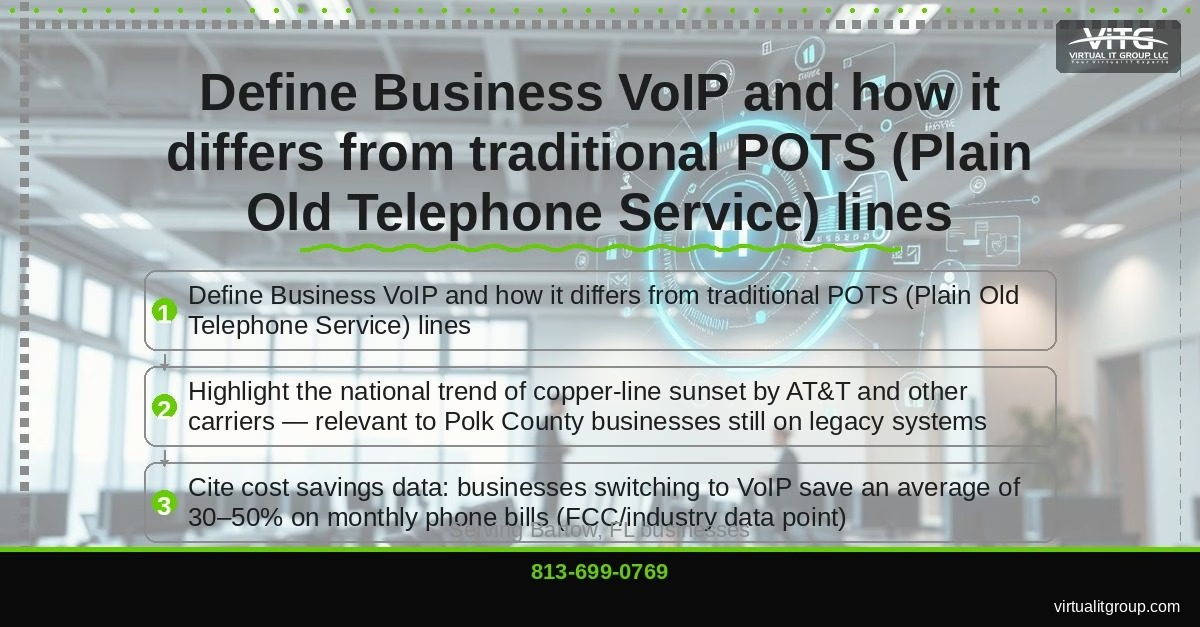
If your Bartow business is still running on traditional copper phone lines, here’s what you need to know right now: AT&T and other major carriers are actively sunsetting POTS (Plain Old Telephone Service) infrastructure, and Polk County businesses that haven’t planned for the transition are going to get caught flat-footed. Business VoIP (Voice over Internet Protocol) routes your calls over broadband internet instead of aging copper lines, and companies that switch typically cut their monthly phone costs by 30–50% while gaining features their old systems couldn’t touch. I’ve spent 20 years helping Tampa Bay businesses modernize their IT infrastructure, and the shift away from legacy phone systems is one of the clearest wins I see on the table for Bartow SMBs right now.
Last Updated: October 19, 2026
This isn’t a trend unique to big cities. Bartow, as Polk County’s seat, has a dense concentration of law firms, insurance agencies, healthcare providers, and government contractors who depend on reliable communications daily. Many of them are still paying $50–$75 per line per month for systems installed 10 or 15 years ago. That math doesn’t work anymore.
Why Are Bartow Businesses Switching to VoIP Phone Systems?
TL;DR: Legacy phone lines are being discontinued by major carriers, cost significantly more than VoIP, and lack the encryption and flexibility modern businesses need. Bartow businesses are switching because the cost savings are real, the features are better, and the old infrastructure is running out of time.
The copper-line sunset isn’t a rumor. AT&T has been filing with state public utility commissions across the country to retire traditional landline service, and Florida businesses are squarely in that transition window. If your Bartow office is still on a Centrex system or a legacy multi-line analog setup, your carrier may already be pushing you toward alternatives — and not necessarily the best ones for your business.
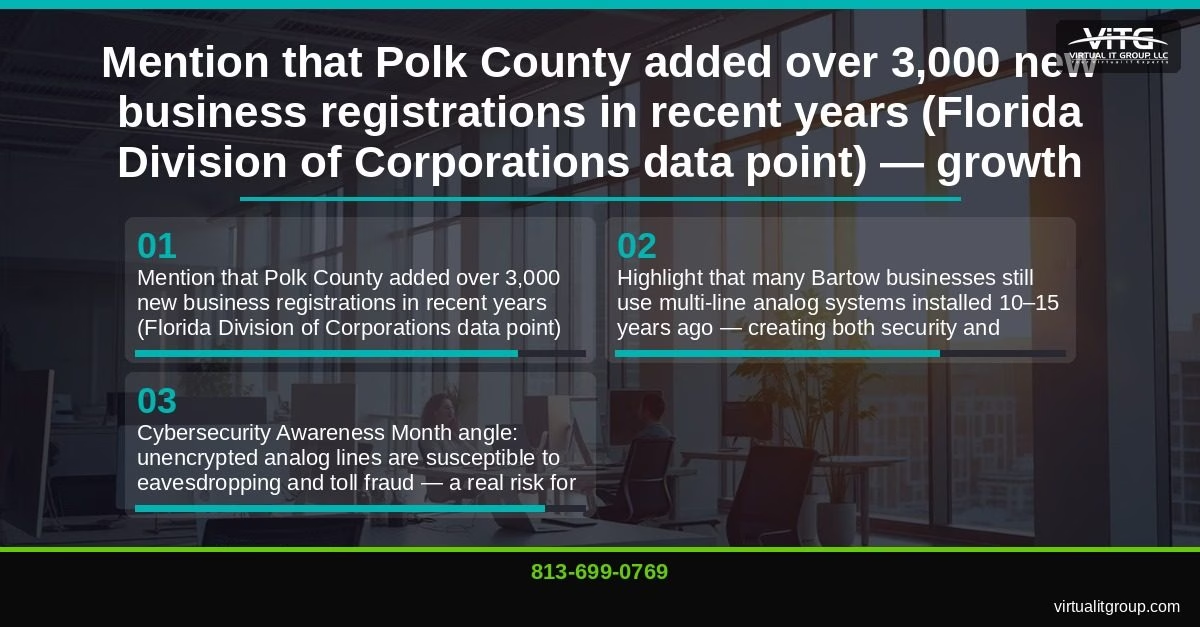
Polk County’s economy adds another layer of urgency. The county added over 3,000 new business registrations in recent years according to Florida Division of Corporations data, and that growth puts pressure on communications infrastructure that was never designed to scale quickly. The phosphate industry, agriculture-tech firms, and the professional services corridor near Lakeland and Publix’s regional footprint all represent businesses that need phone systems that grow with them, not against them.
October is Cybersecurity Awareness Month, and I’ll use that as a direct hook: analog phone lines have zero encryption. Anyone with physical access to the right junction box can listen to your calls. For a Bartow law firm or insurance agency handling sensitive client conversations, that’s not a theoretical risk — it’s a compliance exposure.
Ready to see what switching would actually cost your business? Call us at (813) 699-0769 and we’ll put together a real comparison for your specific setup.
What Is the State of Business Communications in Bartow and Polk County Right Now?
TL;DR: Most Bartow businesses are running phone systems that are 10–15 years old, creating security gaps and scalability problems that VoIP directly solves. The professional services industries dominant in Polk County have the most to gain from switching.
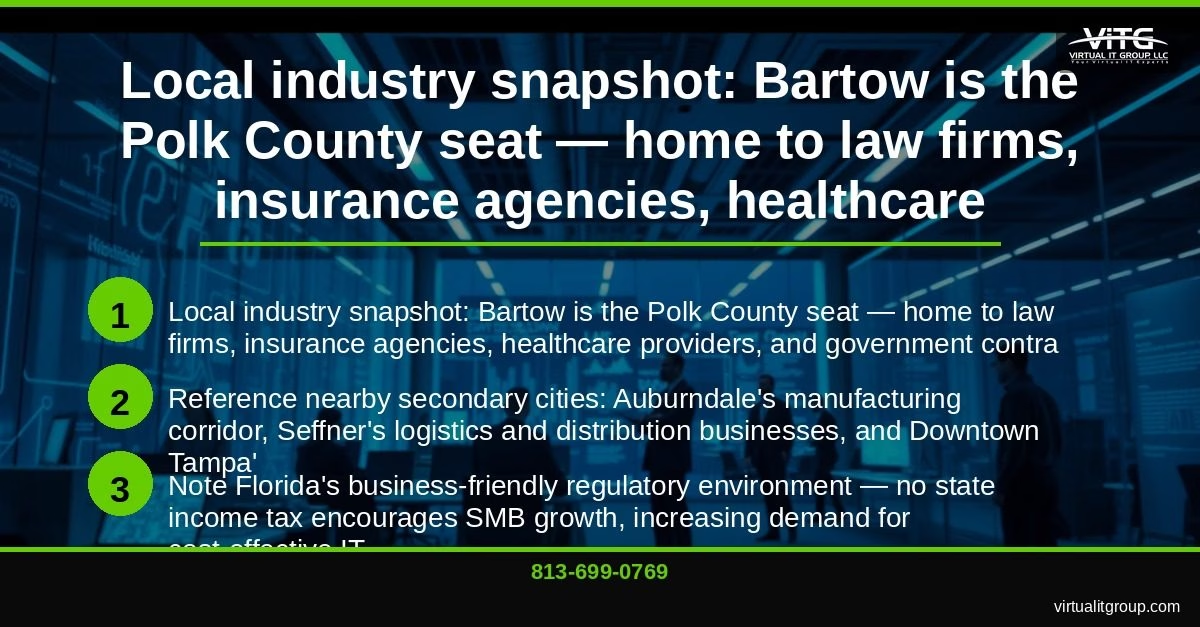
Bartow is not a sleepy county seat. The legal community here is active, the healthcare sector is growing, and there’s a significant population of government contractors and financial services firms that handle sensitive communications every day. I’ve talked to business owners in Auburndale’s manufacturing corridor and Seffner’s logistics and distribution companies who are running the same phone system they installed when Obama was in his first term. That’s not nostalgia — that’s a liability.
Florida’s business-friendly regulatory environment, including no state income tax, has accelerated SMB formation across the Tampa Bay region. More businesses means more demand for scalable, cost-effective IT infrastructure. The problem is that many of those new and growing businesses inherit or default to legacy phone setups because “the phones work.” They work until they don’t, and when a 20-line analog system fails, you’re looking at a technician visit, parts availability issues, and potential days of disruption.
Unencrypted analog lines are also a direct vector for toll fraud, where attackers exploit your phone system to make international calls at your expense. This is a documented, rising threat — not hypothetical. For Bartow legal and financial firms, the exposure extends to client confidentiality obligations under Florida Bar rules and SEC/FINRA communication retention requirements.
If this sounds like your situation, call (813) 699-0769 — we’ll walk through what a modernization plan looks like for your specific business without any obligation.
What Is Business VoIP and How Does It Work for Small Businesses?
Business VoIP is a communications technology that transmits voice calls over a broadband internet connection instead of traditional copper telephone lines. Rather than paying for dedicated physical circuits, your calls travel as data packets over the same internet connection your office already uses for email and web browsing.
For a Bartow SMB without a dedicated IT staff, the hosted VoIP model is almost always the right choice. Here’s why: with hosted VoIP, the phone system infrastructure lives in the cloud at your provider’s data centers. You get desk phones or software applications on laptops and mobile devices, and all the backend management — updates, security patches, capacity scaling — happens without you touching anything.
The features that come standard with modern hosted VoIP would have cost thousands per month on a legacy PBX system:
- Auto-attendant — greets callers and routes them without a receptionist
- Voicemail-to-email — audio files delivered directly to your inbox
- Mobile app integration — your office number rings on your cell phone
- Call forwarding and ring groups — distribute calls across your team intelligently
- Video conferencing — built in, not bolted on
- Multi-location extensions — a Bartow office and a Downtown Tampa office share one unified system
On the bandwidth side, each VoIP call uses roughly 100 kbps. A 10-line office needs about 1 Mbps dedicated to voice — well within what standard cable or fiber broadband in Polk County provides. Most businesses we assess are already VoIP-ready from an internet standpoint.
Security is built into modern VoIP platforms, not added as an afterthought. TLS (Transport Layer Security) and SRTP (Secure Real-time Transport Protocol) encryption protect calls in transit. Multi-factor authentication locks down admin portals. Call logging supports compliance audits.
Cybersecurity Awareness Month reminder: Unprotected VoIP systems are a primary target for toll fraud and social engineering attacks. Attackers scan for open SIP ports and exploit misconfigured systems to rack up international call charges — sometimes thousands of dollars overnight. Ask us about secure VoIP deployment: (813) 699-0769.
Key takeaway: Hosted Business VoIP gives Bartow SMBs enterprise-grade phone features at a fraction of the cost, with security and scalability that legacy analog systems simply cannot match.
How Much Can Bartow Businesses Save by Switching to VoIP?
TL;DR: Traditional business landlines cost $50–$75 per line per month. Hosted VoIP averages $20–$35 per line per month. For a 10-person Bartow office, that’s a savings of $3,600–$4,800 per year before accounting for eliminated long-distance charges and hardware costs.
Let me make this concrete. A 10-person Bartow insurance agency running a legacy Centrex system with 10 lines is likely paying $600–$750 per month just for line access. Switch to hosted VoIP and that same capacity costs $200–$350 per month. That’s over $4,800 in annual savings on the phone bill alone.
Then there’s long-distance. VoIP treats local, long-distance, and many international calls identically — there’s no separate per-minute charge for calling a client in Orlando, Tampa, or Atlanta. For Bartow businesses with clients spread across Central Florida or out of state, this alone can eliminate a meaningful monthly expense.
Hardware is another savings category people underestimate. Legacy PBX systems require expensive on-site equipment that depreciates, needs maintenance contracts, and eventually needs full replacement. Hosted VoIP requires desk phones (optional — softphones on laptops work fine) and nothing else. No PBX box, no maintenance contract, no truck rolls when something needs to change.
Scalability is where the math gets really interesting. Adding a line to a legacy system means scheduling a technician, waiting for availability, and paying an installation fee. Adding a VoIP line takes about three minutes in an admin portal and costs nothing beyond the monthly per-seat fee. When Polk County businesses grow — and they are growing — that flexibility has real dollar value.
I’ll be honest: when we first started doing VoIP cost comparisons for clients, I thought the savings would be modest. Turns out the combination of line costs, long-distance elimination, and hardware savings consistently delivers 40–55% total cost reduction. The FCC’s consumer guidance on VoIP corroborates the 30–50% savings range as an industry benchmark.
That freed budget matters. One of our clients — a 35-person Tampa marketing agency — consolidated seven separate IT vendor relationships (internet, phones, security, cloud, and support) under one managed agreement with Virtual IT Group, LLC. We reduced their vendor management overhead by 80% and cut total IT costs by 30%. The savings went straight into cybersecurity tools they’d been putting off for two years.
Key takeaway: Bartow businesses switching from traditional landlines to hosted VoIP typically save 40–55% on monthly phone costs, with additional savings from eliminated long-distance charges, no PBX hardware, and zero-cost line scaling.
Is Business VoIP Secure Enough for Bartow’s Legal, Healthcare, and Financial Firms?
TL;DR: Yes — but only with proper configuration. Out-of-the-box VoIP without firewall hardening, VLAN segmentation, and encrypted SIP trunks is vulnerable. With correct setup, VoIP meets HIPAA, legal ethics, and financial compliance requirements.
This is the question I get most often from Bartow’s professional services firms, and I understand why. A healthcare provider under HIPAA or a law firm under Florida Bar communication rules can’t just plug in a new phone system and hope it’s compliant. The stakes are real.
For healthcare clients in Polk County, HIPAA compliance requires a Business Associate Agreement (BAA) with your VoIP provider, encrypted call recording if you record calls, and documented access controls. Not every VoIP provider offers a BAA — that’s a critical vetting step that Virtual IT Group, LLC handles as part of every healthcare deployment. We’ve seen practices get burned by consumer-grade VoIP platforms that don’t offer BAAs and don’t disclose that limitation upfront.
For legal and financial firms, the requirements center on call recording retention, data access controls, and audit logging. Enterprise VoIP platforms built for regulated industries include all of these. The configuration, though, matters enormously.
Here’s my direct take on VoIP security: “VoIP security is not optional — it requires proper firewall configuration, SIP ALG settings, and VLAN segmentation to protect business communications.” SIP ALG (Application Layer Gateway), which is enabled by default on many consumer routers, actually breaks VoIP security rather than helping it. We disable it on every deployment. VLAN segmentation keeps your voice traffic isolated from your data network, limiting the blast radius if any device is compromised.
The threat landscape is documented and serious. Both the Cybersecurity and Infrastructure Security Agency (CISA) and the FBI’s Internet Crime Complaint Center have issued advisories specifically on VoIP-targeted attacks, including toll fraud, vishing (voice phishing), and SIP trunk exploitation. October’s Cybersecurity Awareness Month is the right time for your Bartow firm to audit whether your phone system is actually protected.

Our security-first VoIP deployment process includes a network assessment before any equipment is provisioned, firewall rule configuration specific to SIP traffic, encrypted trunk setup, VLAN design for voice isolation, and ongoing monitoring. It’s not a product sale — it’s a managed deployment.
Key takeaway: Business VoIP is fully compliant with HIPAA, legal ethics rules, and financial regulations when deployed correctly — including BAA-compliant providers, encrypted SIP trunks, VLAN segmentation, and proper firewall configuration. Virtual IT Group, LLC handles all of this for Bartow’s regulated industries.
Why Do Bartow and Polk County Businesses Choose Virtual IT Group for VoIP?
Most national VoIP resellers will sell you a platform and send you a setup guide. That’s not what Bartow businesses need, and it’s not what we do.
Virtual IT Group, LLC has been serving Tampa Bay and Polk County SMBs for 20 years. We were deploying VoIP solutions before most of today’s cloud providers existed. That history matters because we’ve seen what goes wrong — the misconfigured firewalls, the carrier porting disasters, the HIPAA-noncompliant deployments that looked fine until an audit. We’ve fixed all of those problems for other businesses, which means we don’t create them for yours.
Our team provides on-site support across Bartow, Auburndale, Seffner, Lakeland, Brandon, Plant City, Winter Haven, and Downtown Tampa. When something needs hands-on attention, we’re there — not on a support ticket queue in another time zone.
VoIP at Virtual IT Group is never a standalone product. It’s deployed as part of a broader managed IT strategy that includes network readiness assessment, security configuration, and ongoing monitoring. Our credentials back that depth: Microsoft Certified and CompTIA Security+ certified, which is a meaningful distinction from a phone system reseller who knows the platform but not the network it runs on.
87% of new clients we assess were overpaying for underperforming IT solutions. The average Tampa Bay SMB spends 6.2% of revenue on IT — but businesses that invest strategically in managed IT see 23% higher operational efficiency. VoIP is one piece of that strategic picture.
As Brian Truman, CEO of Virtual IT Group, puts it: “Technology should be an accelerator for your business, not a constant source of frustration. If your team is complaining about IT more than once a week, something is fundamentally broken in your IT strategy.”
Our service area covers the full Tampa Bay region:
- Bartow, FL
- Auburndale, FL
- Seffner, FL
- Downtown Tampa, FL
- Lakeland, FL
- Brandon, FL
- Plant City, FL
- Winter Haven, FL
- Tampa Bay Region, FL
Virtual IT Group, LLC | (813) 699-0769 | virtualitgroup.com
This Cybersecurity Awareness Month, don’t overlook your phone system. Contact Virtual IT Group for a free VoIP security assessment and cost comparison for your Bartow business. Call (813) 699-0769 or visit virtualitgroup.com to schedule your no-obligation consultation.

Frequently Asked Questions: Business VoIP in Bartow, FL
Can Bartow businesses keep their existing phone numbers when switching to VoIP?
Yes. Number porting is a standard part of every VoIP migration, and you keep your existing Bartow phone numbers throughout the process. Virtual IT Group, LLC manages the entire porting process with your current carrier, coordinating the cutover to minimize disruption. Most Polk County businesses experience zero downtime during the number transfer when the migration is properly planned.
What internet speed does a Polk County office need for reliable Business VoIP?
Each VoIP call uses approximately 100 kbps of bandwidth. A 10-line Bartow office needs roughly 1–2 Mbps dedicated to voice traffic — well within what standard cable or fiber broadband in Polk County provides. Before any deployment, Virtual IT Group conducts a free network readiness assessment to confirm your connection quality, latency, and jitter levels meet VoIP performance standards. Most businesses we assess are already ready.
Is Business VoIP secure enough for HIPAA-regulated businesses in Bartow, FL?
Yes, with proper configuration. HIPAA-compliant VoIP requires a Business Associate Agreement (BAA) with your provider, encrypted SIP trunks using TLS/SRTP, VLAN segmentation to isolate voice traffic, and documented access controls. Virtual IT Group, LLC vets providers for BAA availability and handles all compliance configuration for Polk County healthcare clients. A standard consumer or small-business VoIP platform without these controls does not meet HIPAA requirements.
How long does Business VoIP setup take for a small business in Bartow?
Most VoIP deployments for Bartow SMBs complete within 1–5 business days for the technical setup, including network configuration, device provisioning, and user training. Number porting from your existing carrier typically takes 7–14 business days, depending on the carrier. Virtual IT Group coordinates both timelines simultaneously so your team is trained and ready before the port completes. The process is straightforward when managed by an experienced provider.
Why should Bartow businesses review their VoIP security during Cybersecurity Awareness Month?
October’s Cybersecurity Awareness Month, recognized by CISA, is a practical prompt for Bartow businesses to audit communications infrastructure that often gets overlooked. VoIP systems without proper firewall rules, SIP ALG disabled, and encrypted trunks are actively targeted for toll fraud — where attackers exploit your system to make international calls at your expense — and vishing attacks that impersonate your business number. A security review takes less than an hour and can identify exposures before they become expensive incidents. Contact Virtual IT Group at (813) 699-0769 for a free VoIP security audit this October.